history

Part four – other things

[I sense by now mum is losing enthusiasm for the task I set her as her narrative somewhat peters out]

“In 1972 Colin’s mother died and his dad came over & spent a month with us, interrupted by a cruise up the coast of Norway, where he met the awful Marilyn, his second wife. We had a lovely time with him & showed him a lot of the S. East of England. He particularly liked the Brighton Pavilion (when a few years later we took Marilyn there she was very unimpressed). It was lovely to really get to know him & for the kids to at least meet one grandparent.

So Ric wouldn’t have to share a bedroom with Michael, Colin extended the cupboard at the top of the stairs into a very compact cabin style bedroom for him. We had another run-in with the librarian neighbours as they thought the building noise would only last two days, not the two weeks it actually took. They really didn’t approve of us, but didn’t think about their own actions – practising scales (badly) on the piano at 6am wasn’t exactly neighbour friendly either.

There was a very large field diagonally across from our house. At the top of this led onto a wide path to the next housing estate. Our kids were allowed to play on the field but not go onto the path. They always wondered how I knew when they’d done this but as I could see the whole field from Michael’s bedroom window and I also dressed them in bright red jumpers, it was easy to check up on them while I was doing the housework.”

Apart from a paragraph about my first teacher, this is where mum’s autobiography ends. I’ve lived in Portsmouth for over forty years now but I’ll do my best to summarise the rest of mum’s story.

Late in 1972 [I think, the 8th December rings a bell] we moved from Rayleigh to Maylandsea on the Dengie peninsular and a branch of the Blackwater River, still in Essex. It was a largish chalet style house down a pot-holed road (that would occasionally take delivery of a lorry of tarmac for everyone on the street to muck in and fill. A temporary fix that would last a few months before all the holes reappeared). Being so far out in the countryside meant we had to bus into school, first to Latchingdon CofE Primary a few miles away where mum also took a job as a dinner lady, having more than one run-in with the eccentric headmaster, Mr Brown, and Mrs Brown his deputy and wife. After about 21 months there I moved on to senior school which meant bussing to Chelmsford, some 18 miles away, because mum could not countenance the idea of us going to the much, much nearer Burnham on Crouch comprehensive. This, for me, involved taking the 11+ exam and acing it to get a choice of schools. It also meant that after-school and other extra-curricular activities were virtually impossible as mum didn’t yet drive and dad was away working a lot. On the other hand we did get involved in 1st Maylandsea Sea Scouts and had many adventures on the water and camping around the county and further afield; from Derbyshire to Andorra and the Black Forest (in winter!).

When I was eighteen and eventually found a place at Portsmouth Polytechnic and moved to the south coast; my family moved to Norfolk (rude). They found a nice house in Hemsby village and proceeded to make it very nice and lived comfortably there for a number of years before they fell victim to the endowment mortgage crisis and had to downsize considerably. They found a small, prefab style bungalow nearby and again made the best of it. Mum’s gardening skills adapted from a large lawned affair to one of principally containers and after losing both Trudi and Domino found great joy in a rescued Irish Terrier called Simpson who slept in an outside kennel and was as daft as the proverbial brush. They became firm Norwich City fans and held season tickets for many years enjoying the many highs and lows of supporting a team that would often yo-yo between divisions and the occasional “club night” in Delia’s restaurant. By now both Michael and I had children and grandparenthood was something they both loved too. Something else they enjoyed immensely was cruising, visiting many places around the world; from Alaska to Argentina, China to the Caribbean, and also closer to home. Consequently we have many photos of “Nana on a bench” from all corners of the globe!

In the late 1980s, before they took to the cruise ship life, they bought a dilapidated old farmhouse in the Mayenne (south of Normandy) in France and spent many years, often going out at Easter, summer and autumn half term, slowly fixing it up with a view eventually to letting it out. It didn’t quite work out that way but we had several free holidays in return for our labour and many adventures in the bricolage before it was eventually finished and they decided to sell up instead of letting as planned. Quite what the new owners made of all the English electrics we’ll never know.

In 1996 mum planned a surprise trip to the relatively new Disneyland Paris to treat the big kid that was my dad for his sixtieth birthday. In return, a year later he tried to outdo mum and took us all to Lapland for the day – the day before Christmas Eve – for her sixtieth, leaving her intricate plans for us all to stay for Christmas in disarray. It was quite the experience though.

In 2015 a surprise revelation from dad during a conversation with friends ended up with them moving to the Isle of Wight that September. Mum remained convinced that he initiated the move so they could be closer to Sarah & me in Portsmouth, as he knew his prostate cancer was slowly bringing his days to an end (he died in April 2018). Mum had ten years on the island altogether and enjoyed it very much, making new friends and being far more active than she had been latterly in Norfolk.

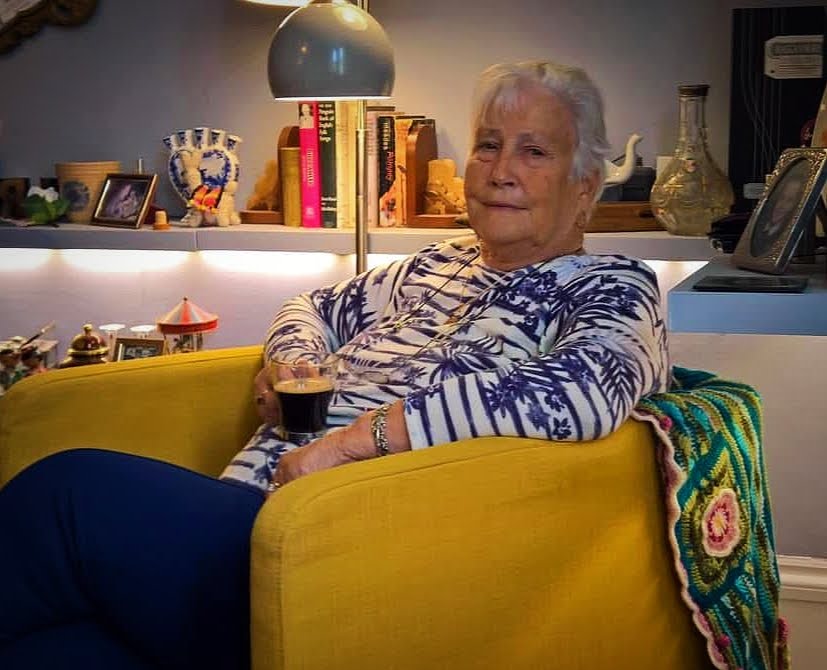
Natalie Ann Robinson 1937 – 2025
Dumfries trip

Since the start of the year I had planned to go up to Dumfries for a poke around the Currie tree and when I mentioned this to Heather during a discussion on the family, she intimated that she was also thinking of such a trip. Anyway, to cut a very boring part of the story short, we met up in Lochmaben late in April.

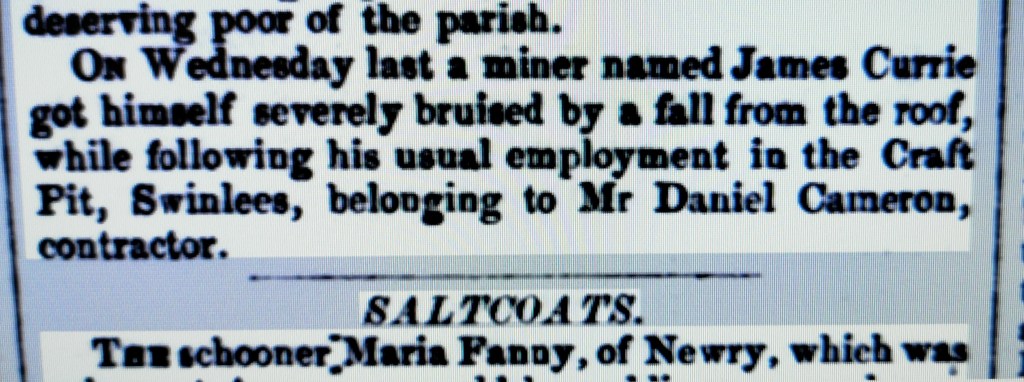
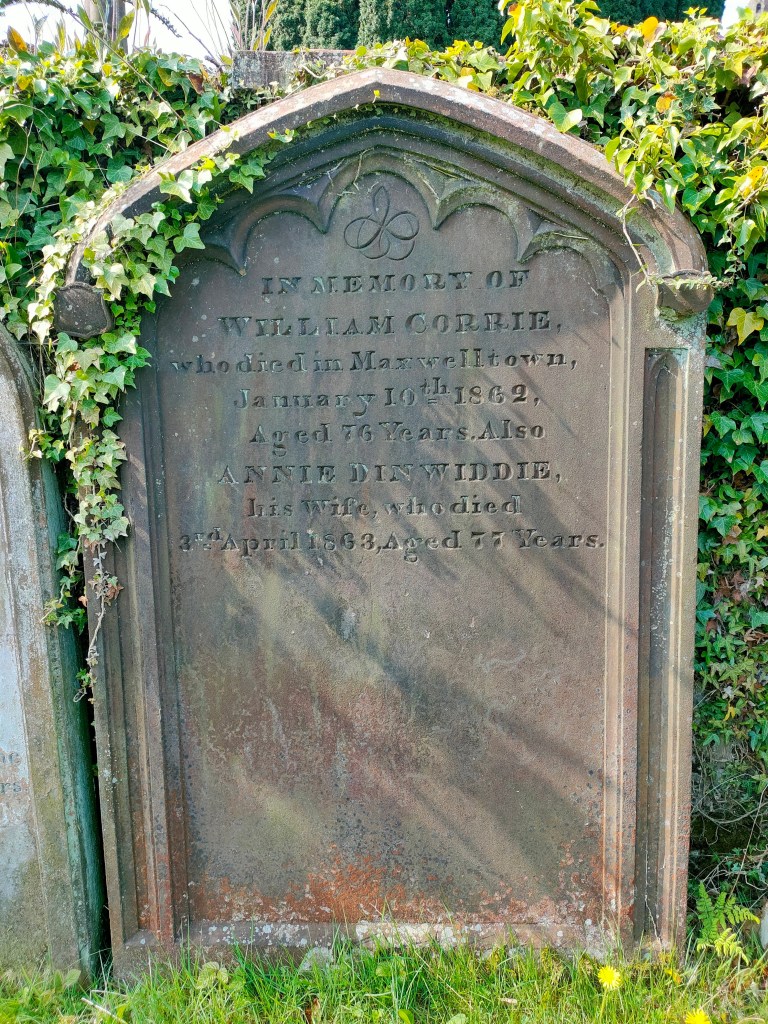
Prior to meeting up, I had stopped off in Penrith in case George was mentioned in the museum (he wasn’t, but I had a nice time there anyway), and after a weekend with friends, arrived in Dumfries on the Monday; later than planned thanks to a broken down train. The next day I spent about four hours scouring records in the Dumfries & Galloway Family History Society office where we found the above snippet and potentially a death record for David Currie. Given the previous state of those brick walls, these chinks of light were welcome indeed. They also had many volumes of monumental inscriptions to browse through so I was able to note down some possible grave locations for the family. I now have an album full of photos of gravestones of various Curries and other associated names.

Meanwhile, Heather had been touring the county tracking down farmhouses and other related locations. We met up, as I said, in Lochmaben on the Wednesday after a minor bus problem and went on a tour of the area – a couple of graveyards, the fascinating Cruck Cottage museum in Torthorwald and, after a stop at an ice cream café, Rockhallhead farm where George and Margaret were married. The farmer was wonderfully welcoming and helpful, the owner of the old farmhouse much less so but we got a picture anyway.

The next day I popped back to the DGFHS to check something and went on to the very good museum with its camera obscura (nice) before taking one last look around St Michael’s churchyard where I eventually found the grave I/we had been looking for, tucked away in an extension behind the Burns mausoleum that I had completely failed to notice on my previous visit.

And there you have it. That evening we met up for a nice dinner at the tapas restaurant before making our farewells and I catching my train home the following morning. A relatively successful and thoroughly enjoyable trip.

Famous skeletons

When you embark upon a genealogical quest you will eventually have to start drawing lines. At some point your tree will start to look more like a hedge unless you limit the number of branches you go down – it is nice to know for example that your second cousin Bob was married to Jean, but you perhaps don’t need to know all of Jean’s ancestors or siblings and their descendants.

You will also, at the start, be hoping that there might be some link to someone famous or notable, someone to start a conversation at dinner perhaps (or maybe only because that will mean an awful lot of work will already have been done for you!).

What this is leading to is that one of the slightly more obscure branches of my tree links in to the Pretorius family, something I hadn’t paid much attention to before. But it would appear that they’re something akin to Afrikaner aristocracy; descendants of Johannes Pretorius who arrived in the Cape in 1666. He was one of the first Dutch settlers and great grandfather of the famous Voortrekker leader Andries Pretorius and great-great-grandfather of the first president of the South African Republic, Marthinus Pretorius.

And also, as it turns out, my eight times great grandfather.

This link to one of the most famous Boer families comes on top of being descended from an 1820 settler.

To put that in some context, I suppose it’s a bit like being descended both from a Pilgrim Father and a Son of the American Revolution.

And I’m not sure how I feel about that.

The case of James Erith and the revolting settlers

James Erith had spent some months petitioning the colonial office to be allowed to lead a party of settlers, first to America and then to the Cape when that opportunity opened up for 1820. It was clear he was keen to be something of an empire builder and also that he saw his role as a leader of men, not a foot soldier. He eventually secured passage for himself, his wife Jane and their two young daughters, his cousin Robert Robinson and his young family, along with eight other young men all of whom were to be indentured to him for some years after settling. For this he raised the princely sum of £105 (well over £4000 today) paid to the government to set against expenses, tools and rations until the settlement was established.
Thomas Baines painting of the landings
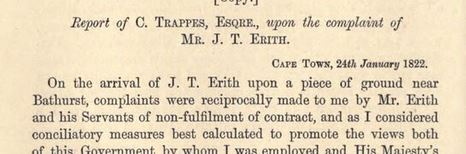
His party, aboard HMS Brilliant arrived at Algoa Bay on 15 May 1820 and it may be that they were already in dispute but the cracks were definitely showing as early as that June when there were complaints to the provisional magistrate, C. Trappes, that rations had not been drawn, they were infested with vermin and the whole party was suffering with bowel complaints due to unclean water. Twice Mr Trappes intervened to settle the differences between the party and Erith, once on behest of the men and then because Erith claimed his party were in a state of mutiny!
excerptEventually forced to intervene again, Trappes called a day to hear grievances and even found work for some of the party in order that they might afford some shoes, and gave out rations charged against Erith’s account.
Some ten weeks into the settlement, the authorities (and who knows what unrecorded conversations took place) decided that parcels of land had been wrongly allocated and that as a result, several parties had to move. Erith’s party was told to relocate to Waay Plaates, which Erith describes as having been abandoned both by the Dutch because of its proximity to the native border and thus at a great risk from cattle raiders, and also by Mr Damant because it was rocky and barren. He was not at all happy. Erith decided to sit it out on his original allocation citing conflicting authority and that the move was motivated by nothing more than private revenge, accusing Trappes and the Landdrost, Rivers, of oppression and injustice. He resisted attempts to move him, claiming illness, firing on those sent to evict them, and destroying wagons. Eventually authority prevailed, knocked down the house Erith had built, evicted him and released his party from their obligations.

There followed several years of correspondence from Erith and Jane, his wife, claiming redress for losses suffered, relief from destitution, and legal grievances against all those involved in what they saw as the architects of their misery.
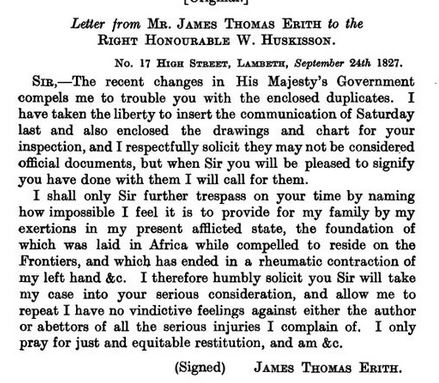
They eventually sought leave to return to England, separately, he to continue his grievance, she because she was destitute. In September 1827 James is in Lambeth, still petitioning, still complaining:
letter
It’s not yet clear whether Jane and the children did return to England, but it appears that James died in 1868 back in South Africa.

Frustrated and a bit disappointed

The trip to Kew turned up very little at all.

The day started brimming with hope even through the remnants of the rush hour traffic. I arrived at 10am, registered for my readers card and started searching. I had a number of references to look at prepared in advance but as you’ll see below they were frustratingly unrevealing. It was also a very long wait for document retrieval, which I wasn’t prepared for. I ended up leaving just after 6pm not much the wiser. It’s a lovely place though, and everyone was very helpful.

I found no sign of Philip Joseph Robinson’s court martial. I looked through four thick ledgers of handwritten records and found nothing. There were also two ledgers in the catalogue listed as “wanting”, meaning they were supposed to be in the archive but somehow hadn’t arrived from the originating body. This didn’t help the growing sense of frustration. Could he have been in them? Probably never know.

There was no sign of Ralph’s East African birth either. If he was born there it was not registered with the British authorities, which still leaves the possibility of PJR being some part, albeit temporary, of the post-war Afrikaner migration and therefore of a Dutch Reformed Church baptism coming to light. More work needs to be done on this.

I could find nothing to add to James Edwards’ met police record. Too much of this record set is missing – there are very few complete service records available and I couldn’t find any correspondence relating to his dismissal.

One of the things I managed to find was the Will of William Robinson. The reason I was looking relates to the 1820 migration to the Cape. Before some of the parties of 1820 Settlers left England bound for South Africa they would meet up, presumably for updates and questions. The Erith Party, of which Robert Robinson was a member, met on Newington Causeway above the Crown and Anchor public house. Another group, curiously, met at Robinson’s Tobacconist on nearby George Street, which has niggled away as possibly being of importance but of which I can find no trace. There was, however, a Robinson’s Tobacconist on Tooley Street, just round the corner, but I now know at least that this was nothing to do with us, which I suppose is a positive of sorts. It’s proprietor was this William Robinson whose only son it turns out was Thomas. Not a Philip to be seen.

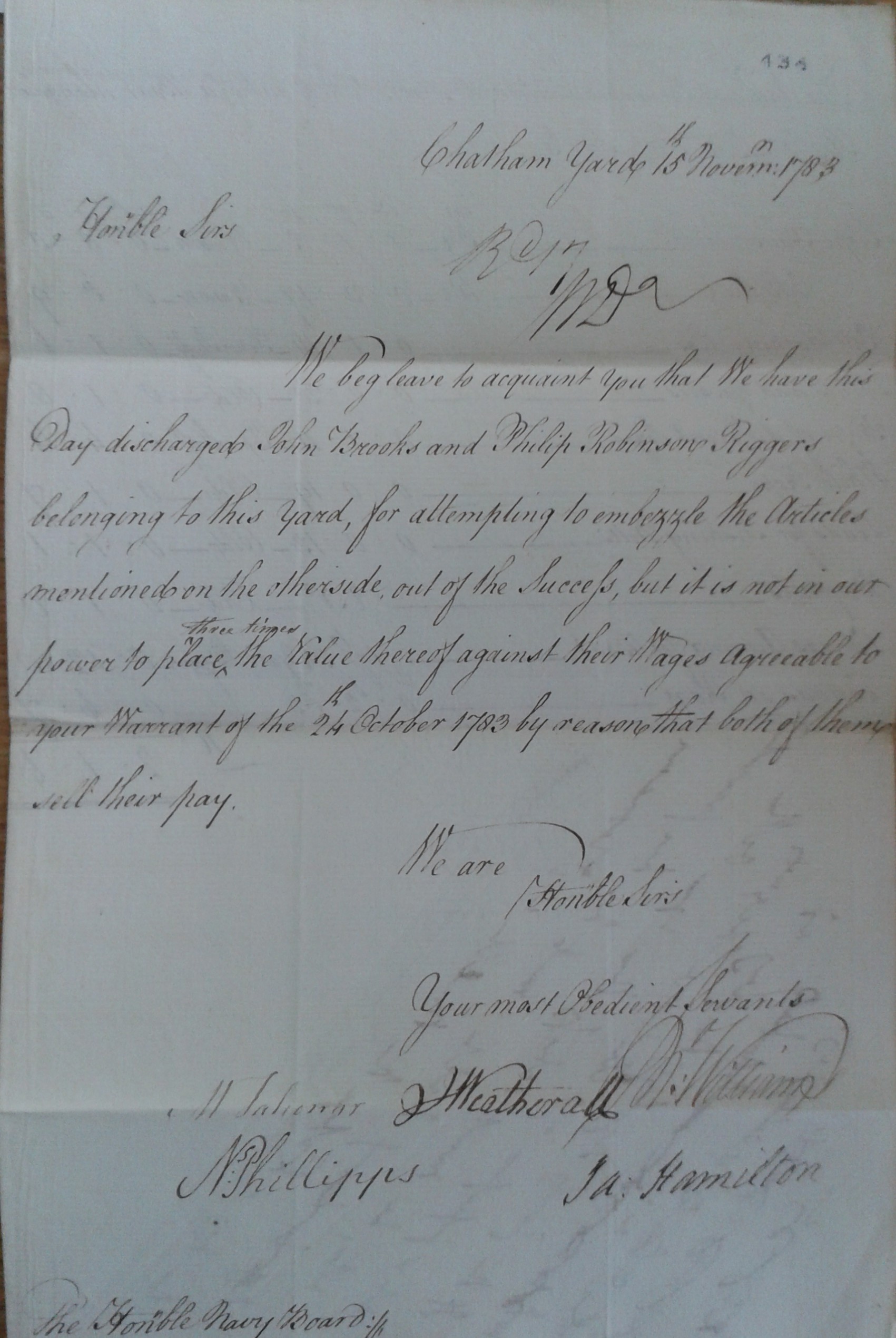
The day’s only faint sliver of hope was a letter

letter

Coming out of Chatham Dockyard on 15th November 1783 it says:

 “We beg leave to acquaint you that we have this day discharged John Brooks and Philip Robinson, Riggers belonging to this yard, for attempting to embezzle the articles mentioned on the otherside [of the letter] out of the Success [a ship], but it is not in our power to place three times the value thereof against their wages agreeable to your warrant of 24th October 1783 by reason that both of them sell(?) their pay…”

Which allows the ever so slight possibility that if this is our Philip (born c.1747), known to be resident in the Chatham area at that time, he may have come to Kent from elsewhere, perhaps even through the Navy. Not that it is possible to prove any link yet, there is no clue as to who his parents were as they are not mentioned on anything yet found. But it’s something and it means the day was not a complete washout.

A brush with minor royalty

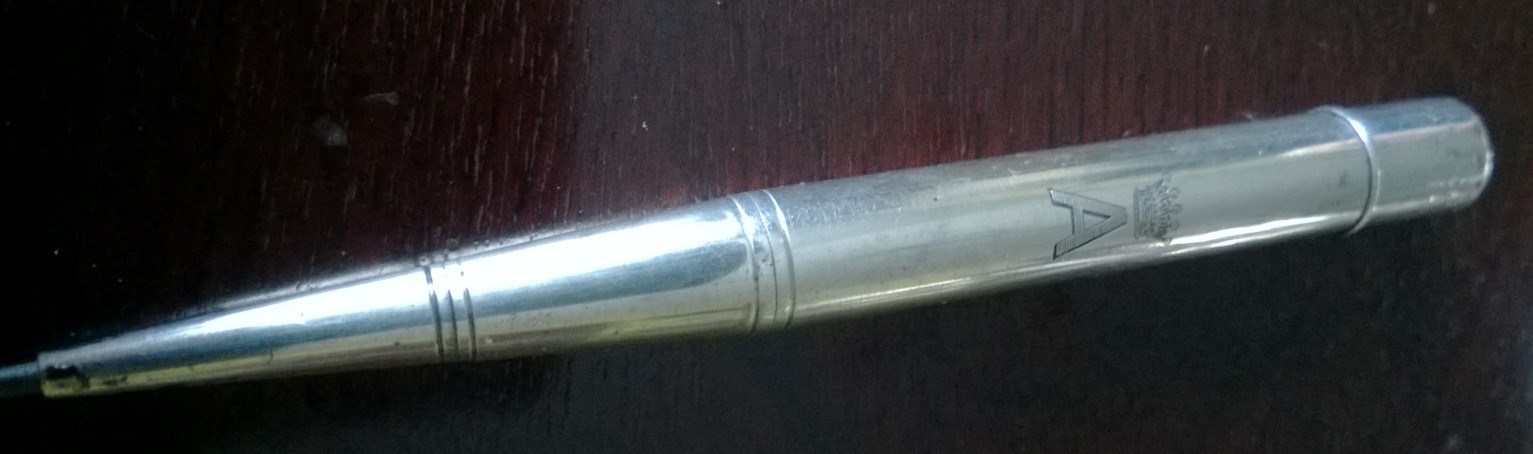
Much as I am vehemently against inherited privilege, my great-grandfather, John Leith, would have been chuffed to receive this gift from the then Governor-General of the Union of South Africa (the Earl of Athlone and husband of Princess Alice, granddaughter of Queen Victoria), on his retirement from the railways.

pencil

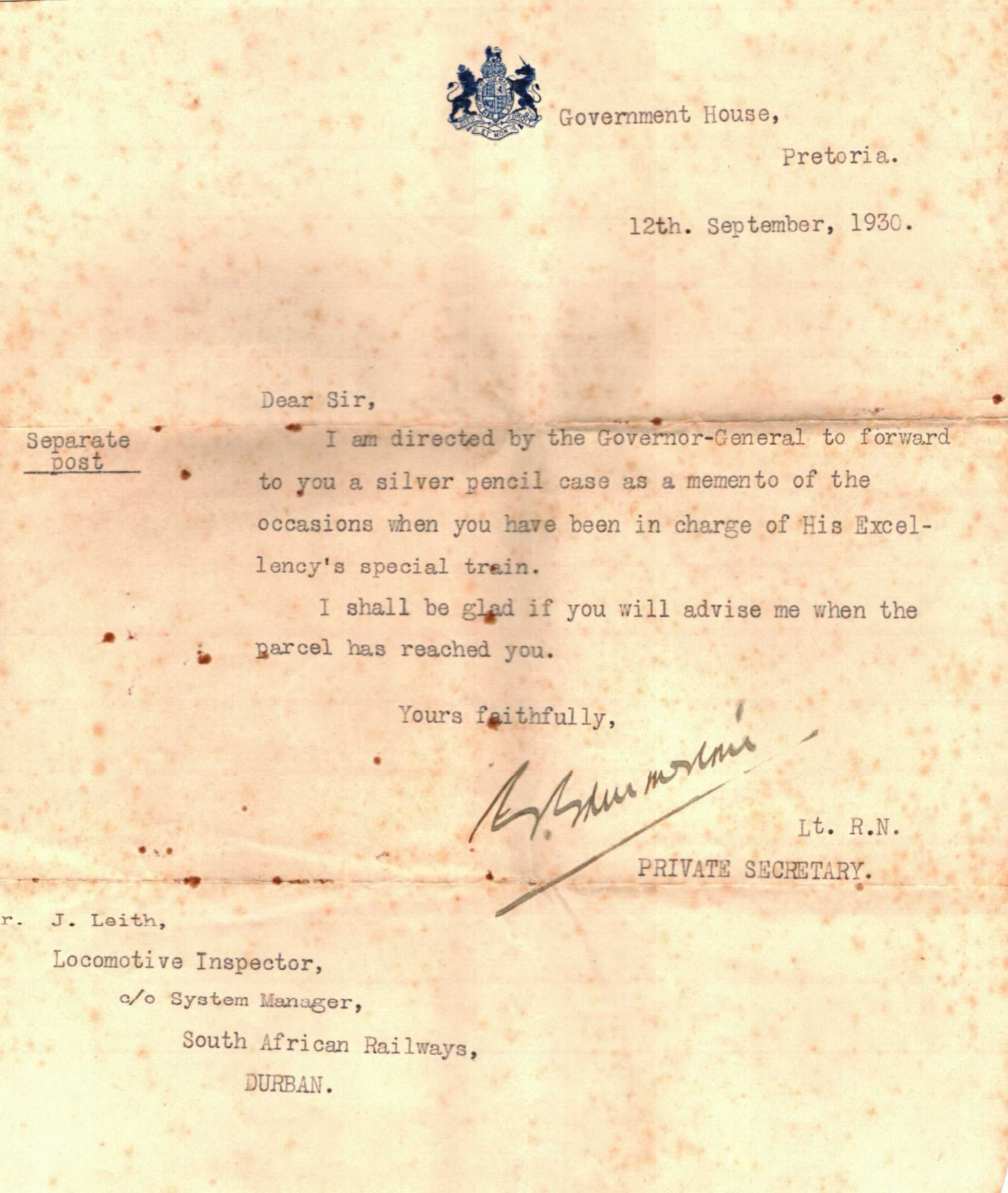
As the following letter shows, John was in charge of the train that the Governor-General often used to travel around the country on his frequent ceremonial tours.

letter

Interesting aside

It’s now almost certain that my dad’s grandfather and my mum’s grandfather were both involved in the Relief of Ladysmith during the Boer War. It’s also true that mum’s same grandfather and dad’s other grandfather were both involved in South Africa’s WW1 campaign in what is now Namibia.

We know they never met in a family setting, perhaps they did in wartime.

Who Do You Think You Are?

I suppose that at some point it behoves the family history blogger to pass comment on the BBC series “Who Do You Think You Are?”. Don’t get me wrong, I find it very entertaining (even the American version); we all enjoy rooting around in the past, most of the subjects have a good story to tell, and there’s always the chance to see a famous person cry. But I wish it would do more.

Telling our ancestor’s stories is most of why we do this (it’s obviously the reason behind this blog), and every now and then we hit a block or notice a gap in the data, and it is for these occasions I believe WDYTYA could be a little more helpful sometimes. It seems like an opportunity missed in that by the end of the current UK series there will have been 100 shows and yet very few of them have offered much practical help to the amateur genealogist. Even if a particular programme or subject has sparked an idea or two, I’m sure I’m not alone in thinking “how did they get that?” when a subject is handed an obscure record to read, falteringly, on camera – ears pricked hoping to hear how one might access this hitherto unheard of archive, but the moment passes and we’re off on the next leg of our stage-managed journey without so much as a subtitle to help us. (I also wonder whether the professionals they use are sometimes ill-served. They hand over research that may have taken days and hours often without so much as a hint that they trawled through several dusty volumes before they eventually found this small clue but that’s by the by).

Of course, genealogy is big business and the BBC and the WDYTYA production company can point to the website and magazine, shrug and say ‘what more do you want?’ but seriously, we have the Red Button and iPlayer; could we not have WDYTYA Extra with content related to each episode? After all, the first series had a short segment at the end of each programme where Adrian Chiles and researcher Nick Barratt offered basic tips – there’s no reason this could not be re-adopted and expanded for WDYTYA Extra. It could work much like the supplementary content we sometimes see on nature programmes (“how we got that shot of copulating snow leopards” or “what it was like camped out on an arctic ice floe filming polar bears”) so the rest of the audience can go on enjoying Brian Blessed’s workhouse ancestors while we can get help finding our own. Everyone is happy.

What do you think?