25 Dec 1937 – 1 Nov 2025
My mum died last week so I thought it was time to tell her story.
Some time ago I asked my parents to write a short autobiography so their memories might not be completely lost once they had gone Dad sent over a shortish Word document which forms the basis of this page, while mum got hold of a decent sized notebook and wrote out the story of her life longhand. I am going to transcribe that story here (with one or two minor edits for privacy’s sake). It will take several posts as she really got into her stride writing it!
Part One – Early years
“My parents met on a Union Castle ship sailing from Durban to Cape Town. My dad was returning to England after working in Beira, Mozambique, for the Cable & Wireless Co., and my mum was on a pleasure trip from Durban with some girl friends in 1930/31. They married at St Columba’s Presbyterian church London on 10th August 1932. My brother, Barry John, was still born in Sept/Oct 1936 and I was born at ‘Kloof’, 246 Avondale Ave, Hinchley Wood on 25.12.1937 at 10.17am.
My dad was in the Territorial Army and was called up in 1938, so until he was demobbed in 1946 I hardly saw him (more later). My maternal grandfather died soon after my parents wedding in 1932 and my grandmother made her home with my parents in between her travels and died in our back bedroom in 1942. I used to have nightmares about her quilt which I think was yellow with small flowers on it. (My earliest memory?) as my mother tried to put it on my bed – I wouldn’t have it.
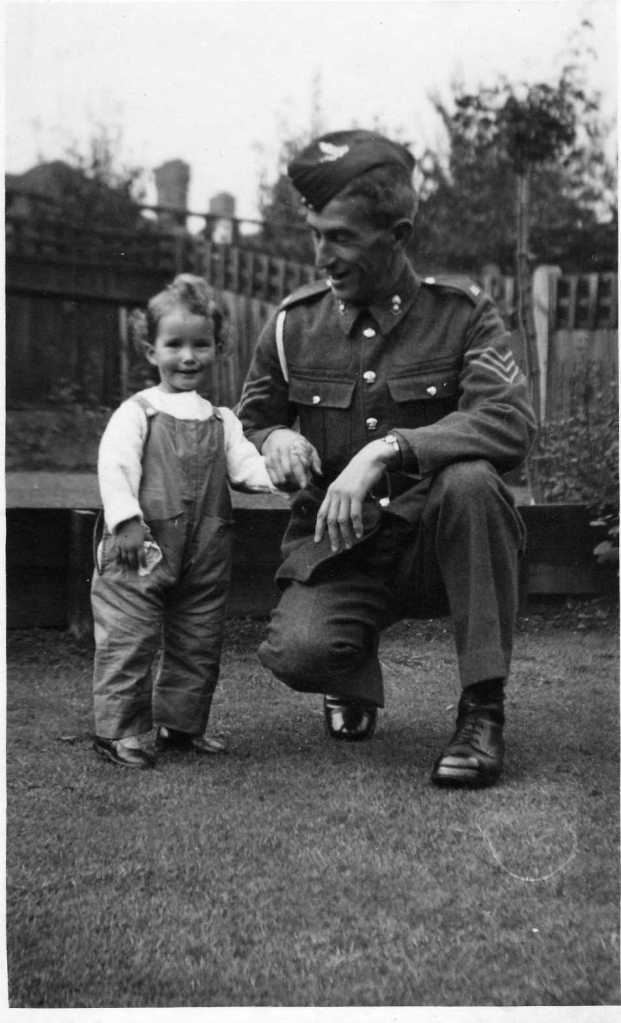
I can remember quite a lot about living at ‘Kloof’. There was a farm at the top of the road with a giant haystack in the field. We loved to play there & were forever being chased off by the farmer. There was also a wide wooded path between the fields with a tiny stream (possibly from a spring) which we used to dam up & play in the thus created pond. “We” were me, Alison Duquid, her younger brother David & two or three others. We were let out after breakfast & had to be home for supper with a packed lunch – summer only of course. When I was old enough for school my mother would walk me through the footpath beside our house & on through to the main A3 road where she handed me over to the senior girls who looked after us on the bus to Esher. The school was divided into boys & girls and had a stove in the corner of our classroom. There was a high wall between the boys & girls play-grounds. I can remember singing lessons – “O, for the wings of a dove”! The senior girls used to walk us home from the bus.
I don’t remember much about the war although I was scared of the noise of the air-raid sirens & for a long time afterwards – even as late as 5-10 years ago I would flinch when I heard the noise of one. We had a large metal-topped shelter in our front room with mesh sides & I think we would often sleep in it – especially when the doodlebugs were coming over. I saw a house lower down the avenue which was demolished by one of these & it scared me a bit. I have also a very clear memory of seeing a plane spiralling to earth with smoke coming out of it. We didn’t do too badly for nourishment during the war as my dad had started a large vegetable garden before the war, and a chicken run, both of which my mother kept going. We also had some food parcels from relatives in South Africa & Australia. I remember nicking a fingerful of what I thought was chocolate spread only to discover the awful taste of Vegemite – I got the hairbrush on my backside to add insult to injury!
My mother who hated living in England was trapped there by the war. Remember she grew up learning to manage a household with servants & then had to do everything herself. On top of the housework she had the vegetable garden, chickens & had to nurse my grandmother through her final illness, so in 1942 she had a breakdown & we were sent down to Abbots Ann near Andover for a few weeks so she could recover. It was a lovely old water mill which had been converted & the mill stream still ran under the living room floor. The relative we stayed with was one of those gruff, no nonsense women who I still remember with affection although I can’t remember her name. While we were there, my mother had sleeping pills & I helped myself to one or two thinking they were sweets. I can remember being kept awake and walked up and down the living room all night! We didn’t stay long as my mother didn’t like leaving the house unoccupied. She also belonged to some organisation which provided some home comforts for Australian & South African service personnel, who would come for a meal & sing-song etc round the piano in the front room. They also gave us some of their rations in return.
On VE Day we went up to London to see the celebrations and I can remember being picked up by some sailors & put on top of aa wall (part of a bomb site) so I could get a better view – but I can’t remember what I saw!
Towards the end of the war & during 1946 mum & I used to travel by train from home via Waterloo to visit Aunt Peggy in Sidcup. She was having trouble coping with 2 children while Bill was away with the forces. Jim was older and quite a help, but Eve was a real handful. We’d take her eggs & veg from the garden and exchange our veg for something different they’d grown. I used to love Waterloo & tried to escape my mother whenever I could – but she always knew where to find me – riding the escalators!! I was only 6-8, but was very good at escape!
In 1946 we had some Australian friends (relations?) come to visit. They had two obnoxious boys, dressed in what to us were incongruous uniforms, who plagued the life out of me behind the adults backs! I eventually snapped and pushed them into a big nettle patch. Needless to say I got a lecture on hospitality and the inevitable hairbrush! My dad was stationed with the Royal Artillery somewhere in North London but was very lucky and missed being sent overseas twice through being in hospital. D-Day he missed through a hernia op, but then in 1946 before being demobbed he was sent to either Kenya or Ethiopia for a short period. He was demobbed in the middle of the year. He got home and my mother pushed him into emigrating to S. Africa. She’d not liked the cold in England, and the shortages etc of the war years were the last straw. He was rather silly to leave his job at C&W as he only had 9 more years before his pension & he lost all that. However this decision was made & in December 1946 our house and contents were auctioned off – I vaguely remember this. We stayed in a hotel in Northumberland Avenue, just behind the S. African embassy where we pent a few days waiting for our final papers. Most of my toys (such as they were after the war) were in the auction, a few were crated up & shipped to Port Elizabeth S.A. and I kept a small doll, her clothes & a couple of books with me in a small attaché case. The day wee left London this was stolen, and most o the toys sent by sea were ruined as the crates were left on the fish dock at P.E. before they were found and returned to us.
We left England on 21.12.46 from Croydon Airport (before the days of Heathrow) and flew to Brussels where we spent 36 hours waiting for a Sabena Airways flight to Africa. I can remember that the hotel had a corridor/reception opening on to a street at each end, & it had a red carpet. It seemed very grand to me – but I suppose that immediately post-war it was probably very shabby.
23rd December we flew to Tripoli in Libya and then flew overnight to Kano in northern Nigeria where we stopped for breakfast and refuelling. I can remember flat roofed, sand coloured buildings & loads of lizards.
24th December we flew from Kano to Leopoldville in northern Congo [now Kinshasa in DRC] & stayed in a pretty hotel with lush gardens – on Christmas morning I had a very small stocking with fruit and an elephant hair and gold bracelet purchased locally. There wasn’t much time to enjoy Christmas as we then flew on to Elizabethville [now Lubumbashi in DRC] where we again spent the night.
26th December we left the Congo & flew down to Rhodesia (either N or South) [Malawi/Zimbabwe] where we touched down for a mail drop & refreshing glasses of fruit juice. We landed in Johannesburg in the afternoon where we were met by Janet Paton and family. She was a school friend of my mother. Her son Hugh was horrible. We then caught the train down to P. Elizabeth & booked into the Balmoral Hotel in Western Road. The next two weeks were busy kitting me out for life in boarding school. The reason for going to PE was because my mother wanted me to go to her old school, Collegiate, which in S Africa was just about on a par with Roedean or Benedon in England. The junior boarding house was a very large bungalow overlooking St George’s Park, called Nahoon. It was owned and run by Mrs McKenzie who lived in the front, and we had the back; two dormitories, dining room, kitchen, sick by & matron’s (Miss Mellor) bedroom & office. There was a long driveway with a pergola over a large back garden. We used to rollerskate down the drive, jump up & swing from the pergola until someone broke her ankle and it was banned. When I started there I was the little waif from wartime England among a crowd of rich farmer’s daughters from the inland veldt. I was completely different and had no experiences in common with the other girls. My mother had made me some very pretty viyella nighties with Peter Pan collars & puff sleeves which caused great amusement to the pyjama clad occupants of my dormitory, and until the prefects put a stop to it, there was a nightly ritual of making me stand on my head! The staff at the hostel also couldn’t understand why I had trouble drinking the full cream milk served up to us. It was so rich it made me gag as I was used to the very thin milk we had during the rationing period. Consequently I still can’t drink a glass of milk.
My parents found work running a hotel right on the beach at a place called Keurboomstrand (beach of the Keur tree) which was on the “Garden Route” near to Plettenburg Bay, about 250miles from PE. It was a rickety old wooden structure set on the edge of a small village. The whole place was later (after 1965) taken over by the military & doesn’t exist any more. We tried to visit it in 1989 but the road was all overgrown and big locked gates stopped our entry. A pity because the beach was superb. In 1948 there was an outbreak of scarlet fever and we were all swabbed to see if we were carriers. I was, as well as two sisters from the country. They were allowed to go home after a few days as they lived on a farm, but as my parents had a hotel, I was incarcerated in the sick-bay for three weeks. I had no contact with the other boarders – the matron was the only person I saw, and that only briefly to bring my meals, check my temperature etc. I had a radio & could go into the garden while the others were at school, and got given one book – “Daddy Longlegs” – grudgingly as it had to be fumigated after me. They wouldn’t believe I could read it in one day and I was told not to be a liar. After lengthy discussions between teh hostel, doctors & the parents of the Leppan sisters who also carried the virus, I was allowed to go to their farm for the final few days I had the virus. None of us had contracted the disease thank goodness as that would have meant the Fever Isolation Hospital.
I did well academically and when it came time to to choose my options for high school an almighty row broke out between my mother and my teachers (a recurring theme). She wanted me to do a domestic science course (perhaps because she’d been so unprepared for life in England) and they wanted me to do an academic course. Luckily the teachers (and maybe my dad) prevailed and started high school in 1950 in the academic group. I don’t think I would have coped with the boredom of sewing my white apron, perfect to the nth degree, so I could then learn to wash up and boil potatoes!
The headmistress was called Miss Brock. She was a desiccated spinster who most strongly resembled a long matchstick. She had very pronounced views on what was acceptable out of school clothing for teenage girls and we all had many a run-in with her over this. The first two years, the uniform was very ugly – navy box pleat gym slips in winter and blue fabric gymslips in summer. We had navy blue suits for church in winter and white pleated dresses in summer. None of the above flattered us in the least. For my last two years we had a uniform revamp and were allowed quite flattering styles of dress. The sixth formers were then allowed to wear stud earrings out of uniform and I had a major run-in with Miss B as my studs were wooden, not the pearls she meant! I was often accuse of being “agin the government” as I didn’t like petty rules for rules sake and would write letters of complaint to my mother who would take it up with the school! One such instance was the snack at tea-time. It was meant to be a slice of bread & jam. The bread was spread with white margarine and you could never guess the colour of the jam – let alone the flavour. After many moans, we got slices of madeira cake or similar.
There were two floors of dorms and a separate block for the sixth formers – two of the balconies were used as overspill beds and I was luck y enough to have one of these beds for a year. Most of the time you were out in the open air, but if it rained we had to let down heavy canvas blinds which had along beam of wood to hold them down. They rattles horribly in storms, but we were a hardy lot & only occasionally gave in and let them evacuate us to the dorm floors.
Our sports field was about 3/4 mile away in St George’s Park and now we were seniors we were allowed to walk there unaccompanied. This meant our group used to sneak to one of the girls’ houses (which was next to the field) for tea & cakes. We played hockey and netball in the winter and tennis & swimming in the summer. I played hockey (left half) as I didn’t like netball. In those days hockey was a much rougher game with fewer rules. I couldn’t play tennis as the racquet my mother got me was far too heavy for the strength of my wrists & every time a ball was hit to me, it took the racquet out of my hand. This occasioned contempt from all the farmers daughters who started playing as soon as they could walk. I was fairly good at swimming although I had a late start. My mother’s friend’s husband, Dip Cooper, threw me in the deep end of the pool and watched till I managed to swim. This was days after my ninth birthday. I had no stamina for long swimming events but I was very good at obstacle races – over barrels, under ropes etc and won the prize most years.
This looks like a convenient spot to pause – to be continued…

