Updated information

Dumfries trip

Since the start of the year I had planned to go up to Dumfries for a poke around the Currie tree and when I mentioned this to Heather during a discussion on the family, she intimated that she was also thinking of such a trip. Anyway, to cut a very boring part of the story short, we met up in Lochmaben late in April.
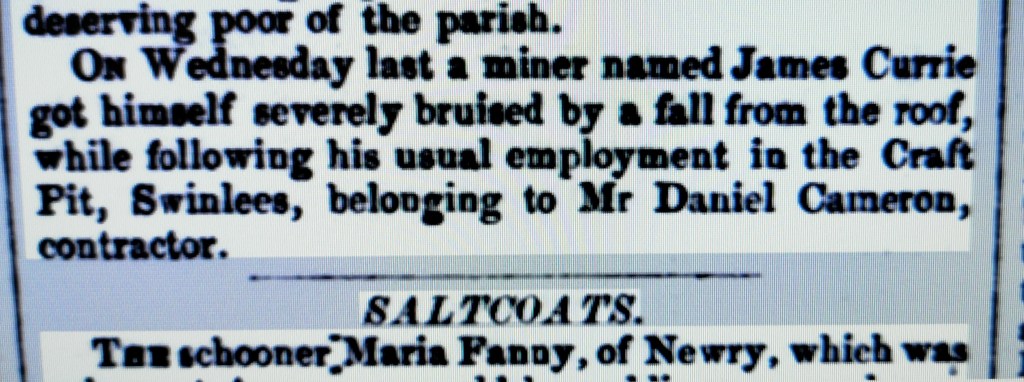
Prior to meeting up, I had stopped off in Penrith in case George was mentioned in the museum (he wasn’t, but I had a nice time there anyway), and after a weekend with friends, arrived in Dumfries on the Monday; later than planned thanks to a broken down train. The next day I spent about four hours scouring records in the Dumfries & Galloway Family History Society office where we found the above snippet and potentially a death record for David Currie. Given the previous state of those brick walls, these chinks of light were welcome indeed. They also had many volumes of monumental inscriptions to browse through so I was able to note down some possible grave locations for the family. I now have an album full of photos of gravestones of various Curries and other associated names.

Meanwhile, Heather had been touring the county tracking down farmhouses and other related locations. We met up, as I said, in Lochmaben on the Wednesday after a minor bus problem and went on a tour of the area – a couple of graveyards, the fascinating Cruck Cottage museum in Torthorwald and, after a stop at an ice cream café, Rockhallhead farm where George and Margaret were married. The farmer was wonderfully welcoming and helpful, the owner of the old farmhouse much less so but we got a picture anyway.

The next day I popped back to the DGFHS to check something and went on to the very good museum with its camera obscura (nice) before taking one last look around St Michael’s churchyard where I eventually found the grave I/we had been looking for, tucked away in an extension behind the Burns mausoleum that I had completely failed to notice on my previous visit.
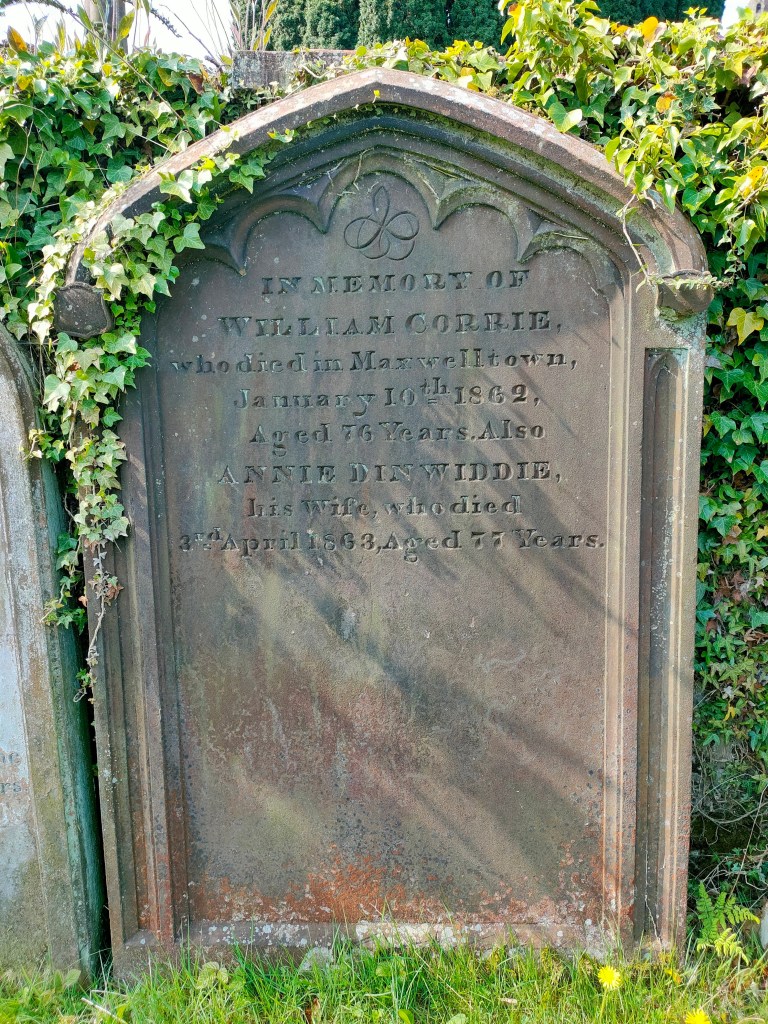
And there you have it. That evening we met up for a nice dinner at the tapas restaurant before making our farewells and I catching my train home the following morning. A relatively successful and thoroughly enjoyable trip.

Sarah Cahill

If you’ve read this, then you’ll know that the name Sarah Cahill was one of the scant fragments of information we had when we started out. I’m happy to say that this particular chapter is now, finally, closed. Sarah Cahill was born Sara Frederika Vercuil in 1860, she married my ancestor Andrew Joseph Robinson in 1877 and bore him two children; my great grandfather, the elusive Philip Joseph, and in 1880 a sister for PJ called Magdalena Catherina. Six years after marrying, Andrew died aged 27 and Sarah married Johan Conradie who died in 1906 after 20 years of marriage.

Knowing at some point she had to have been married to a Cahill, I have finally established who and when that was. James Henry Cahill married the widow Conradie in 1907 but she was wearing black again four years later when he himself died in 1911. Sarah lived until 1945 without marrying again.

The story of Sarah Cahill is now closed as far as I’m concerned. I have no further interest in Mr Cahill or Mr Conradie and Sarah’s own ancestry (probably Dutch) is of only passing interest insofar as actively researching it is concerned. It’s very satisfying to tick that particular box in the initial research file (albeit metaphorically) though, as it neatly rounds off everything Dad started with.

.

Today at Kew

What do you call it if your wild goose is caught?

Okay, perhaps “caught” is stretching a point in this instance but I now feel fairly confident that my ancestor Philip Robinson was indeed a rigger at Chatham Yard. I found a little time today to get to the National Archives and trawling both Chatham’s “ordinary” and “extraordinary” pay books for the period, I found that Philip was listed as a rigger for the three quarters before November 1783 (when, you’ll remember, he managed to get himself dismissed for attempting to embezzle supplies from HMS Success) and that before this he had been a rigger’s labourer.

The document retrieval system at Kew does not allow for rapid perusal so I can’t say yet when his employment as a rigger’s labourer started, but I did also notice that he was working alongside one Alexander Erith. Further, if slight, evidence in favour of this Philip being right.

Finding Edith

The problem with finding records in South Africa is just that – finding them. Sometimes you have to approach your problem somewhat obliquely, and sometimes you find a record that may possibly be the one you’re looking for but your uncertainty affects your decision to send for it or not. Sometimes you just forget what you’ve seen.

Such a thing happened earlier this year. As you know if you’ve read this blog, I’m looking for my grandfather’s siblings in an attempt to put a lid on my great grandfather’s story, as well as putting the family back together – if only virtually.

In January I get sent a reference to a record in Durban regarding the death notice of a Cornelius De Jager whose surviving spouse is Pauline Edith. I’m not sure why I didn’t pursue it earlier, after all the name is just switched around, and we did believe she had married a de Jager; it’s just the sort of oblique approach I meant. I did spend a little time looking at Cornelius Duggan De Jager and traced his parentage but could not find any further mention of Pauline, especially not a maiden name, and so still didn’t send for the record.

Anyway, by September (2015) I’ve gathered a number of leads I need to follow up and include the de Jager DN. The other requests come through quickly, they were regarding Andrew Joseph Robinson and his erstwhile wife Rhoda and confirmed a number of things, but the de Jager order didn’t come through for another month.

When it does, it’s all there – Surviving spouse: Pauline Edith de Jager, with “(born Robinson)” squeezed in underneath. They have five children; Douglas, Gerrit, Elma, Melva and Edith. They were married on 6th June 1929 when he was about 28 and she roughly 24. He was born in Prieska, they married in Kimberley and he died in Durban in February 1962.

So Edith/Pauline was still alive in 1962 at least, which starts to narrow the search for her demise, and we also have five children to search for in case they know what became of their grandfather.

We now have a developing picture of the lives of four of granddad’s five siblings; Andrew, Ralph, Connie and now Edith, it’s now just Doris we know so little about.

Earliest ancestors

Just a quick look at the earliest ancestor found on each of the four branches (my grandparents) of the family.

For the ROBINSON side, the earliest Robinson is still Philip, born c. 1746 but overall we have Wessel Schulte, born in Niedersarchen, Germany in 1566.

On the CURRIE side we reach the furthest back of all to one Richard Mossop born in Gosforth, Cumbria in 1490. The earliest Currie is David born 1825 in Dumfries.

We haven’t fared so well on the ELLICOTT side, although there is still a lot of data to sort through. So far it’s Robert Ellacott born in 1625 who is at least the earliest of the four names found.

Finally, the LEITH side is the least documented with Francis Foster born in 1785 the narrow ‘winner’, although there is tell of a mysterious “Mr Leitch” who would have been born a bit earlier. Otherwise the earliest Leith is John, born about 1800 in Slaght.

So in terms of generations:

Philip Robinson – is my 5 times great grandfather
Wessel Schulte – 11 times great

Richard Mossop – 13 times great
David Currie – 4 times

Robert Ellacott – 9 times

Francis Foster – only 3 times
John Leith – 4 times

Famous skeletons

When you embark upon a genealogical quest you will eventually have to start drawing lines. At some point your tree will start to look more like a hedge unless you limit the number of branches you go down – it is nice to know for example that your second cousin Bob was married to Jean, but you perhaps don’t need to know all of Jean’s ancestors or siblings and their descendants.

You will also, at the start, be hoping that there might be some link to someone famous or notable, someone to start a conversation at dinner perhaps (or maybe only because that will mean an awful lot of work will already have been done for you!).

What this is leading to is that one of the slightly more obscure branches of my tree links in to the Pretorius family, something I hadn’t paid much attention to before. But it would appear that they’re something akin to Afrikaner aristocracy; descendants of Johannes Pretorius who arrived in the Cape in 1666. He was one of the first Dutch settlers and great grandfather of the famous Voortrekker leader Andries Pretorius and great-great-grandfather of the first president of the South African Republic, Marthinus Pretorius.

And also, as it turns out, my eight times great grandfather.

This link to one of the most famous Boer families comes on top of being descended from an 1820 settler.

To put that in some context, I suppose it’s a bit like being descended both from a Pilgrim Father and a Son of the American Revolution.

And I’m not sure how I feel about that.

Charts

I’ve put together (ok, exported from Ancestry) some pedigree charts for my grandparents’ lines. They’re to be found at the foot of the Robinson, Currie, Ellicott and Leith pages in the top menu and I hope they will help make new connections.

Brief update

Many, many searches have been done and many, many document sets have been trawled, all to little avail.

There is still not much to report after weeks of searching for the perennially elusive Philip Joseph Robinson or his wife Louisa Anderson, although there is a family of Andersons from Harrismith that look a promising match without as yet an explicit link back to Louisa.

Having said that, there has actually been some progress around the periphery. A lot more has been found about Ralph Victor Robinson, PJR’s eldest son and my great-uncle. For instance Ralph was married and divorced twice – first to Lauretta Twentyman-Jones and later to Patricia Campbell (née Mayer). Both marriages were short-lived and apparently produced only one child. None of which sheds much light on the main search for his father’s birth and death, except for perhaps the most interesting thing discovered about Ralph, and which I nearly missed.

The marriage register for the wedding of Ralph and Lauretta in Wynberg says that he was born in “East Africa”, which came as a bit of a curve-ball. It means that shortly after Philip and Louisa married in 1903 and before he was employed back at De Beers in Kimberley in 1905 the couple were in British East Africa, presumably taking a chance on what briefly looked like a new land of opportunity. Much more to be discovered and the final push I needed to get up to the archives.

I’m off to Kew on the 16th.

Edwards update

record entry

Just a quick note to update on the progress tracing James Edwards’ family. We now know that James joined the Metropolitan Police (warrant number 26177) on 25 September 1848 and was transferred to Devonport naval dockyard in 1861 (the Met were the force who policed the royal dockyards, not the local bobbies). He left the police in 1866 under something of a cloud – he was dismissed, but I’ll have to go to Kew to access his records to see why. He was a dairyman when he died in 1881.

We think his son William Henry who was born shortly after arriving in Plymouth, became a coach painter and/or a mason and we think we can trace him in the 1911 census and there’s a possibility he died in 1912 but we can’t as yet be certain. There are too many William Henrys to be sure of anything right now.

John Hodder Edwards, James’s eldest son, was a cabinet maker and was lodging with the Bovey household in St Mary Church after his mother Mary (née Rowe) died in 1890. What became of him after that remains a mystery.

We’ve had better luck tracing their surviving daughter, Elizabeth Kate Edwards. She never married and ended her days in 1932 in domestic service. Her death certificate shows that Alfred E. Ellicott, her cousin, was present at her death, and living only two doors down from her in Babbacombe Road.

A natural death?

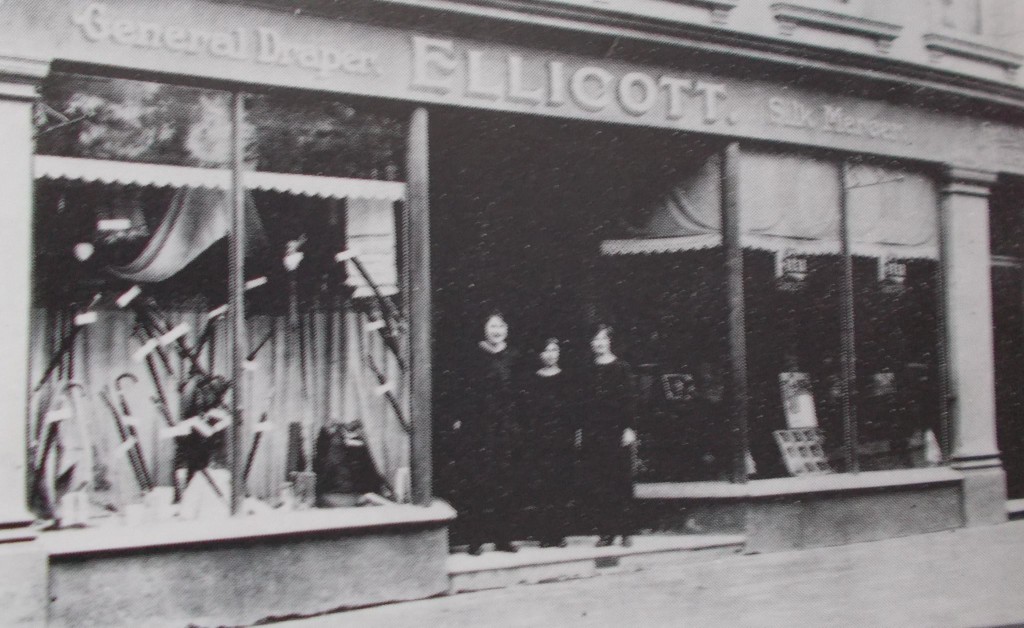
Ellicott ShopIt seems that the Ellicott drapery business may have died a natural death. In 1926 when it was being wound up, Alfred was 56 and his sisters Annie and Adela were 59 and 70 respectively. Julia, the family milliner had married in 1911 aged 39 and had probably moved away – her husband Fred Bidwell died in Southampton in 1932. So it looks like the sisters had moved or retired prompting the move to “Ellicott & Son” in 1923 in an attempt to keep it going. The son in question must have been William because as I’ve mentioned before, Ted was in the Seychelles with Cable & Wireless and Stan was an engineer and it is now clear was on a ship bound for Lagos as the business was closing.

William married Peggy Brunsdon, who was from Swindon, in Gloucester in early 1929 and moved to South East London soon after, so it seems likely that his interest in the business had rapidly waned, if he was interested at all. This must have prompted Alfred to close the business and retire. Unfortunately I haven’t been able to discover William’s occupation yet but it looks unlikely to have been drapery.