hunt

Dumfries trip

Since the start of the year I had planned to go up to Dumfries for a poke around the Currie tree and when I mentioned this to Heather during a discussion on the family, she intimated that she was also thinking of such a trip. Anyway, to cut a very boring part of the story short, we met up in Lochmaben late in April.
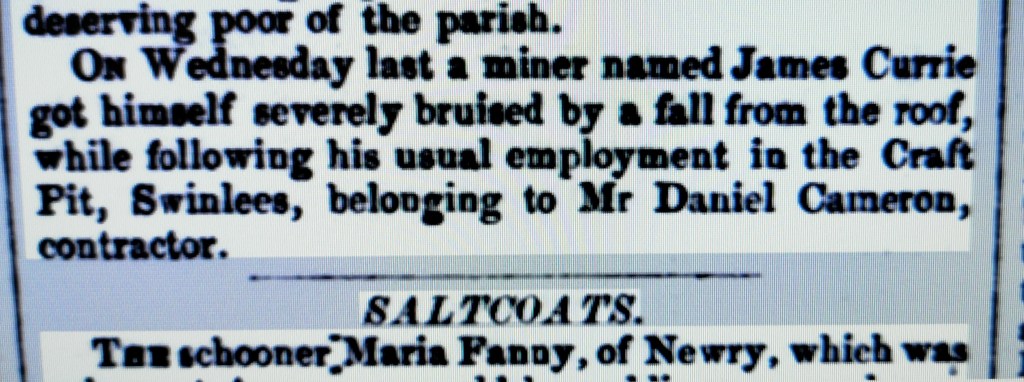
Prior to meeting up, I had stopped off in Penrith in case George was mentioned in the museum (he wasn’t, but I had a nice time there anyway), and after a weekend with friends, arrived in Dumfries on the Monday; later than planned thanks to a broken down train. The next day I spent about four hours scouring records in the Dumfries & Galloway Family History Society office where we found the above snippet and potentially a death record for David Currie. Given the previous state of those brick walls, these chinks of light were welcome indeed. They also had many volumes of monumental inscriptions to browse through so I was able to note down some possible grave locations for the family. I now have an album full of photos of gravestones of various Curries and other associated names.

Meanwhile, Heather had been touring the county tracking down farmhouses and other related locations. We met up, as I said, in Lochmaben on the Wednesday after a minor bus problem and went on a tour of the area – a couple of graveyards, the fascinating Cruck Cottage museum in Torthorwald and, after a stop at an ice cream café, Rockhallhead farm where George and Margaret were married. The farmer was wonderfully welcoming and helpful, the owner of the old farmhouse much less so but we got a picture anyway.

The next day I popped back to the DGFHS to check something and went on to the very good museum with its camera obscura (nice) before taking one last look around St Michael’s churchyard where I eventually found the grave I/we had been looking for, tucked away in an extension behind the Burns mausoleum that I had completely failed to notice on my previous visit.
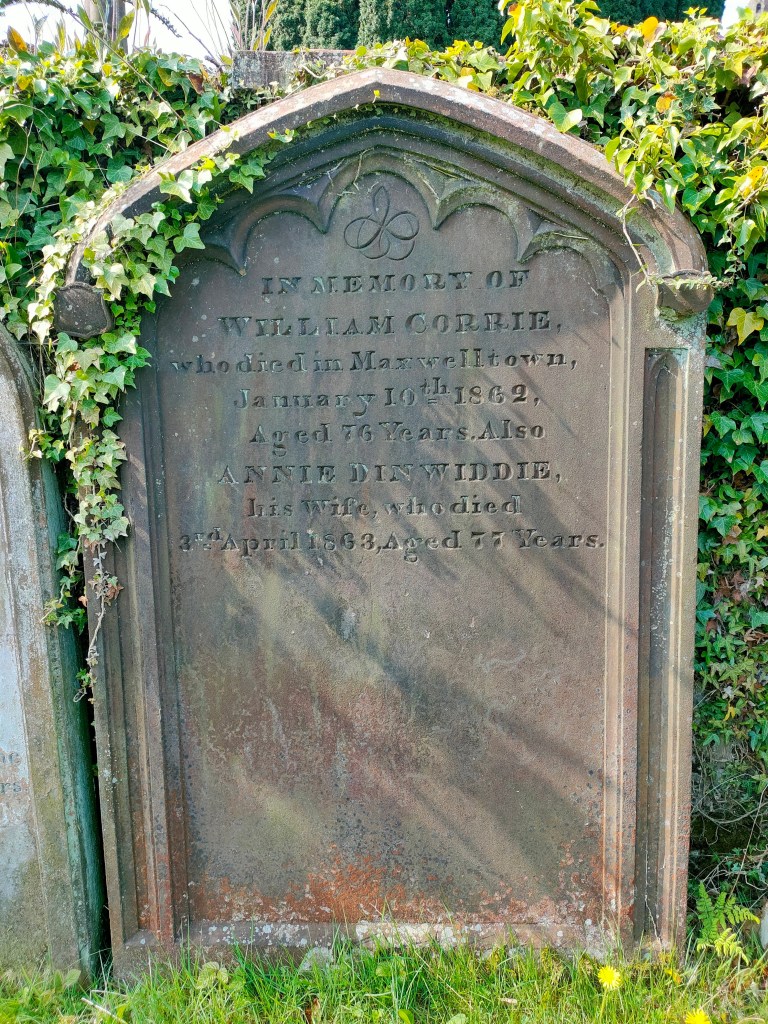
And there you have it. That evening we met up for a nice dinner at the tapas restaurant before making our farewells and I catching my train home the following morning. A relatively successful and thoroughly enjoyable trip.
Sarah Cahill

If you’ve read this, then you’ll know that the name Sarah Cahill was one of the scant fragments of information we had when we started out. I’m happy to say that this particular chapter is now, finally, closed. Sarah Cahill was born Sara Frederika Vercuil in 1860, she married my ancestor Andrew Joseph Robinson in 1877 and bore him two children; my great grandfather, the elusive Philip Joseph, and in 1880 a sister for PJ called Magdalena Catherina. Six years after marrying, Andrew died aged 27 and Sarah married Johan Conradie who died in 1906 after 20 years of marriage.

Knowing at some point she had to have been married to a Cahill, I have finally established who and when that was. James Henry Cahill married the widow Conradie in 1907 but she was wearing black again four years later when he himself died in 1911. Sarah lived until 1945 without marrying again.

The story of Sarah Cahill is now closed as far as I’m concerned. I have no further interest in Mr Cahill or Mr Conradie and Sarah’s own ancestry (probably Dutch) is of only passing interest insofar as actively researching it is concerned. It’s very satisfying to tick that particular box in the initial research file (albeit metaphorically) though, as it neatly rounds off everything Dad started with.

.

Leith shenanigans

First Post in a while, it’s been a funny ol time.

Anyway, Don got back in touch and then Marilyn and so the last few days have been spent trying to square the various circles in the Leith tree, and with some success. It’s certainly a lot tidier but the ultimate aim of definitely tying my 3xgreat grandfather, Archibald (1829-1878), to his putative siblings Andrew, Samuel and John has not been fully realised. Civil records for that time just don’t exist.

An interesting aside concerns Achibald’s children, specifically the two daughters he appears to have had called Mary. Both survived to adulthood, both got married, both seem to be his daughter. Interesting conundrum.

Quick update – Mary Ann Foster

So far it seems Mary Ann Foster has managed to cross continents unrecorded.

Thanks to some help from Rootschat, I’ve found that at the time of her father’s death in 1898 Mary was living in Cheltenham, a suburb of Melbourne, Victoria. I still believe she was a nurse, but have also discovered she wasn’t trained at the Royal Melbourne Hospital and can still not find her on any list of Australian nurses bound for the Cape.

The next time we know her whereabouts is August 1902 when, presumably because of her impending nuptials, she asked for and received confirmation of her birth record from the Victorian State Statist, Richard Treacey. This shows that she was in South Africa shortly after the conclusion of the Anglo Boer War and, it can be surmised, she hadn’t just arrived if she had got engaged that summer.

So, sometime between 1898 and summer 1902 she crossed the Indian Ocean. There’s a searchable index of passengers leaving Victoria to foreign climes and as far as I can see, she’s not on it. There is a Miss Foster bound for Fremantle and it is possible that she travelled there first (her sister Matilda was married and living in Perth) which is great, but passenger lists for those leaving Western Australia are not so easily found. Update: I found the arrival manifest which has been digitised on the WA archives site, and while the Victoria archive suggests a Miss M Foster left Melbourne on the Wollowra, she’s not listed when it gets to Fremantle. So frustrating.

Noticing things

It’s funny what you notice when you’re not really looking.

I’ve been both a bit disheartened after Kew and busy with other things, so haven’t been actively looking for anything in the family history for weeks. However, some time ago I made a list of things I should be doing in this field, one of which was to track down the nursing credentials of Mary Ann Foster. I had another cursory look today and there’s still nothing showing on any of the records of Australian nurses at the Boer War. A bit disappointing but not unexpected.

Anyway, I started to look at it from another angle given that there were a number of nurses who travelled to South Africa from Australia but were not part of any official party. Passenger lists are an obvious option and I was about to start searching for them but then I got distracted. Just going over things known, I was reading the reports of her father’s demise when it struck me that she wasn’t there – the reports only mention her younger sister Margaret and later the husband of her older sibling, Sarah, as pall-bearer. Mary Ann would have been 26 by this time and although still single could, in theory, be anywhere in the world, so the chances that she would show up on any official Australian list of nurses becomes more slight not better. Just the sort of puzzle one needs to kick-start the research juices.

The game is afoot!

Frustrated and a bit disappointed

The trip to Kew turned up very little at all.

The day started brimming with hope even through the remnants of the rush hour traffic. I arrived at 10am, registered for my readers card and started searching. I had a number of references to look at prepared in advance but as you’ll see below they were frustratingly unrevealing. It was also a very long wait for document retrieval, which I wasn’t prepared for. I ended up leaving just after 6pm not much the wiser. It’s a lovely place though, and everyone was very helpful.

I found no sign of Philip Joseph Robinson’s court martial. I looked through four thick ledgers of handwritten records and found nothing. There were also two ledgers in the catalogue listed as “wanting”, meaning they were supposed to be in the archive but somehow hadn’t arrived from the originating body. This didn’t help the growing sense of frustration. Could he have been in them? Probably never know.

There was no sign of Ralph’s East African birth either. If he was born there it was not registered with the British authorities, which still leaves the possibility of PJR being some part, albeit temporary, of the post-war Afrikaner migration and therefore of a Dutch Reformed Church baptism coming to light. More work needs to be done on this.

I could find nothing to add to James Edwards’ met police record. Too much of this record set is missing – there are very few complete service records available and I couldn’t find any correspondence relating to his dismissal.

One of the things I managed to find was the Will of William Robinson. The reason I was looking relates to the 1820 migration to the Cape. Before some of the parties of 1820 Settlers left England bound for South Africa they would meet up, presumably for updates and questions. The Erith Party, of which Robert Robinson was a member, met on Newington Causeway above the Crown and Anchor public house. Another group, curiously, met at Robinson’s Tobacconist on nearby George Street, which has niggled away as possibly being of importance but of which I can find no trace. There was, however, a Robinson’s Tobacconist on Tooley Street, just round the corner, but I now know at least that this was nothing to do with us, which I suppose is a positive of sorts. It’s proprietor was this William Robinson whose only son it turns out was Thomas. Not a Philip to be seen.

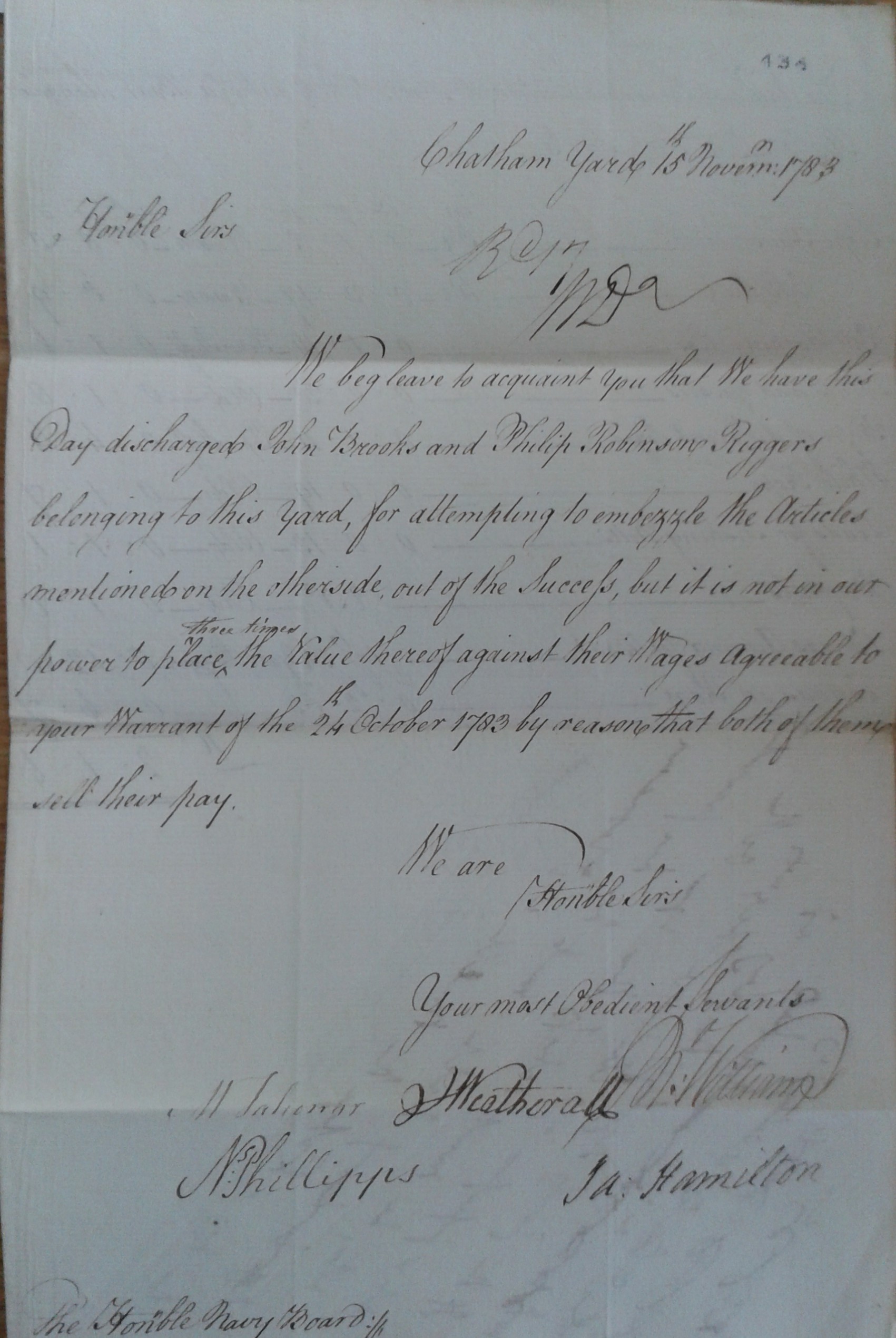
The day’s only faint sliver of hope was a letter

letter

Coming out of Chatham Dockyard on 15th November 1783 it says:

 “We beg leave to acquaint you that we have this day discharged John Brooks and Philip Robinson, Riggers belonging to this yard, for attempting to embezzle the articles mentioned on the otherside [of the letter] out of the Success [a ship], but it is not in our power to place three times the value thereof against their wages agreeable to your warrant of 24th October 1783 by reason that both of them sell(?) their pay…”

Which allows the ever so slight possibility that if this is our Philip (born c.1747), known to be resident in the Chatham area at that time, he may have come to Kent from elsewhere, perhaps even through the Navy. Not that it is possible to prove any link yet, there is no clue as to who his parents were as they are not mentioned on anything yet found. But it’s something and it means the day was not a complete washout.

Brief update

Many, many searches have been done and many, many document sets have been trawled, all to little avail.

There is still not much to report after weeks of searching for the perennially elusive Philip Joseph Robinson or his wife Louisa Anderson, although there is a family of Andersons from Harrismith that look a promising match without as yet an explicit link back to Louisa.

Having said that, there has actually been some progress around the periphery. A lot more has been found about Ralph Victor Robinson, PJR’s eldest son and my great-uncle. For instance Ralph was married and divorced twice – first to Lauretta Twentyman-Jones and later to Patricia Campbell (née Mayer). Both marriages were short-lived and apparently produced only one child. None of which sheds much light on the main search for his father’s birth and death, except for perhaps the most interesting thing discovered about Ralph, and which I nearly missed.

The marriage register for the wedding of Ralph and Lauretta in Wynberg says that he was born in “East Africa”, which came as a bit of a curve-ball. It means that shortly after Philip and Louisa married in 1903 and before he was employed back at De Beers in Kimberley in 1905 the couple were in British East Africa, presumably taking a chance on what briefly looked like a new land of opportunity. Much more to be discovered and the final push I needed to get up to the archives.

I’m off to Kew on the 16th.

A Slippery Fish

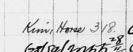
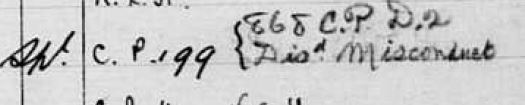
The earlier teaser post included this image taken from the medal rolls of the Kimberley Horse.

Intriguing

Note the numbers 868 and 199, the apparent numbers assigned to PJ Robinson while serving in the Cape Police.

The full entry shows how any medal supposedly earned for his service in the Anglo-Boer War was not issued (note the crossed out entry):

Exhibita

(and what does “H.O.” mean?)

The initials “P.J.” could be Patrick John for instance, so how do we know that this refers to Philip Joseph Robinson?

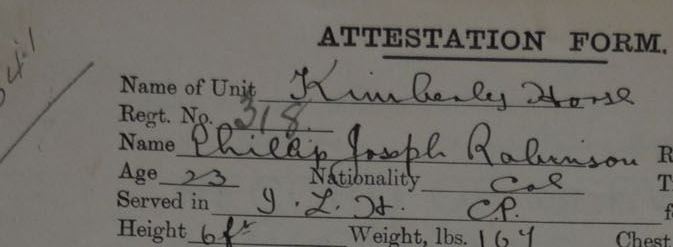
Take a look at this close-up of Philip’s attestation paper for the Kimberley Horse;

Exhibit1

The important details are; his name (obviously), his regimental number (318, matching the record above) and that he previously served in I.L.H and C.P. vis the Imperial Light Horse and Cape Police.

So far, so good.

I couldn’t find any mention of him in the ILH rolls but did find mention of PJ Robinson in the Cape Police medal rolls (Anglo-Boer War): Here is the name:

exhibit3Again, the number 199 matches that on the Kimberley Horse record, and at the other end of that line is this:
exhibit2
So the two match. 199 Sergeant PJ Robinson of the Cape Police was also 318 Corporal PJ Robinson of the Kimberley Horse.

So who’s this?
exhibit4

And what did he do?
exhibit5
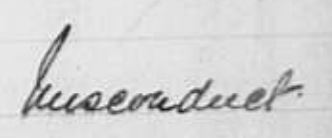
This is the only other PJ Robinson I have so far found in the Cape Police rolls; Peter Joseph Robinson, but matching number 868 and also discharged for misconduct. Typo? Perhaps a mix up of two different people’s records? Could it even be that the misconduct was giving a false name? At this stage, who knows?

But we do know Philip was prone to a name change…

Phillip Joseph here, Philip Joseph Hercules on his marriage certificate, just Joseph on his wife’s estate papers, no wonder he’s proving difficult to pin down!

Radio silence broken

I haven’t posted anything for two weeks (and the blog views have dried up as a result) and there’s a reason for this – I’ve been busy! Every spare moment that I can spend on genealogy (which is really not much when there are so many other demands on my time) has been spent looking into a family of Edwards’s. Not even my Edwards’s – not directly anyway – those of my second great grand uncle.

Kath got in touch recently and after exchanging some pertinent information (see earlier post) asked if i could look some things up for her so she could draw a line under a particular family. So for the last few days there has been an ever lengthening email trail between me here in the UK and her in Australia. With the two of us rarely awake at the same time it’s been interesting to see what has landed in my inbox of a morning.

The gist of the story is that James Edwards goes to London from Somerset in the late 1840s to become a policeman. He marries Mary Rowe and they have four children (one dies in infancy, another in childhood) before moving to Devonport and having another child. James dies in 1881 and Mary in 1890 from which point the fates of the children (by now young adults) becomes very difficult to trace. We get to the turn of the century ok but then they all seem to disappear and we can find nothing concrete in the censuses of 1901 or 1911, no certain marriages, no deaths to be sure of and they don’t seem to have left the country. It’s puzzling and the sort of challenge that makes us all carry on this genealogy lark.