1820

Famous skeletons

When you embark upon a genealogical quest you will eventually have to start drawing lines. At some point your tree will start to look more like a hedge unless you limit the number of branches you go down – it is nice to know for example that your second cousin Bob was married to Jean, but you perhaps don’t need to know all of Jean’s ancestors or siblings and their descendants.

You will also, at the start, be hoping that there might be some link to someone famous or notable, someone to start a conversation at dinner perhaps (or maybe only because that will mean an awful lot of work will already have been done for you!).

What this is leading to is that one of the slightly more obscure branches of my tree links in to the Pretorius family, something I hadn’t paid much attention to before. But it would appear that they’re something akin to Afrikaner aristocracy; descendants of Johannes Pretorius who arrived in the Cape in 1666. He was one of the first Dutch settlers and great grandfather of the famous Voortrekker leader Andries Pretorius and great-great-grandfather of the first president of the South African Republic, Marthinus Pretorius.

And also, as it turns out, my eight times great grandfather.

This link to one of the most famous Boer families comes on top of being descended from an 1820 settler.

To put that in some context, I suppose it’s a bit like being descended both from a Pilgrim Father and a Son of the American Revolution.

And I’m not sure how I feel about that.

The case of James Erith and the revolting settlers

James Erith had spent some months petitioning the colonial office to be allowed to lead a party of settlers, first to America and then to the Cape when that opportunity opened up for 1820. It was clear he was keen to be something of an empire builder and also that he saw his role as a leader of men, not a foot soldier. He eventually secured passage for himself, his wife Jane and their two young daughters, his cousin Robert Robinson and his young family, along with eight other young men all of whom were to be indentured to him for some years after settling. For this he raised the princely sum of £105 (well over £4000 today) paid to the government to set against expenses, tools and rations until the settlement was established.
Thomas Baines painting of the landings
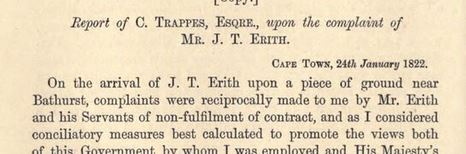
His party, aboard HMS Brilliant arrived at Algoa Bay on 15 May 1820 and it may be that they were already in dispute but the cracks were definitely showing as early as that June when there were complaints to the provisional magistrate, C. Trappes, that rations had not been drawn, they were infested with vermin and the whole party was suffering with bowel complaints due to unclean water. Twice Mr Trappes intervened to settle the differences between the party and Erith, once on behest of the men and then because Erith claimed his party were in a state of mutiny!
excerptEventually forced to intervene again, Trappes called a day to hear grievances and even found work for some of the party in order that they might afford some shoes, and gave out rations charged against Erith’s account.
Some ten weeks into the settlement, the authorities (and who knows what unrecorded conversations took place) decided that parcels of land had been wrongly allocated and that as a result, several parties had to move. Erith’s party was told to relocate to Waay Plaates, which Erith describes as having been abandoned both by the Dutch because of its proximity to the native border and thus at a great risk from cattle raiders, and also by Mr Damant because it was rocky and barren. He was not at all happy. Erith decided to sit it out on his original allocation citing conflicting authority and that the move was motivated by nothing more than private revenge, accusing Trappes and the Landdrost, Rivers, of oppression and injustice. He resisted attempts to move him, claiming illness, firing on those sent to evict them, and destroying wagons. Eventually authority prevailed, knocked down the house Erith had built, evicted him and released his party from their obligations.

There followed several years of correspondence from Erith and Jane, his wife, claiming redress for losses suffered, relief from destitution, and legal grievances against all those involved in what they saw as the architects of their misery.
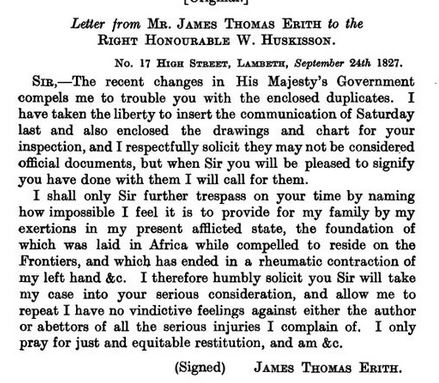
They eventually sought leave to return to England, separately, he to continue his grievance, she because she was destitute. In September 1827 James is in Lambeth, still petitioning, still complaining:
letter
It’s not yet clear whether Jane and the children did return to England, but it appears that James died in 1868 back in South Africa.

Erith’s story

Mocavo have finally proved useful. They have digitised a whole raft of South African journals and official records including several volumes of “Records of the Cape Colony”, among which we find nearly all the correspondence relating to James Erith’s disputes with his party and the colonial government. Erith was the lead member of the party of settlers joined by Robert Robinson and his young family but said party also fell apart with disputes and recriminations soon after landing at Algoa Bay.

It’ll take a while to read and extract the story to tell but it’s quite an exciting development.

Stay tuned.

Frustrated and a bit disappointed

The trip to Kew turned up very little at all.

The day started brimming with hope even through the remnants of the rush hour traffic. I arrived at 10am, registered for my readers card and started searching. I had a number of references to look at prepared in advance but as you’ll see below they were frustratingly unrevealing. It was also a very long wait for document retrieval, which I wasn’t prepared for. I ended up leaving just after 6pm not much the wiser. It’s a lovely place though, and everyone was very helpful.

I found no sign of Philip Joseph Robinson’s court martial. I looked through four thick ledgers of handwritten records and found nothing. There were also two ledgers in the catalogue listed as “wanting”, meaning they were supposed to be in the archive but somehow hadn’t arrived from the originating body. This didn’t help the growing sense of frustration. Could he have been in them? Probably never know.

There was no sign of Ralph’s East African birth either. If he was born there it was not registered with the British authorities, which still leaves the possibility of PJR being some part, albeit temporary, of the post-war Afrikaner migration and therefore of a Dutch Reformed Church baptism coming to light. More work needs to be done on this.

I could find nothing to add to James Edwards’ met police record. Too much of this record set is missing – there are very few complete service records available and I couldn’t find any correspondence relating to his dismissal.

One of the things I managed to find was the Will of William Robinson. The reason I was looking relates to the 1820 migration to the Cape. Before some of the parties of 1820 Settlers left England bound for South Africa they would meet up, presumably for updates and questions. The Erith Party, of which Robert Robinson was a member, met on Newington Causeway above the Crown and Anchor public house. Another group, curiously, met at Robinson’s Tobacconist on nearby George Street, which has niggled away as possibly being of importance but of which I can find no trace. There was, however, a Robinson’s Tobacconist on Tooley Street, just round the corner, but I now know at least that this was nothing to do with us, which I suppose is a positive of sorts. It’s proprietor was this William Robinson whose only son it turns out was Thomas. Not a Philip to be seen.

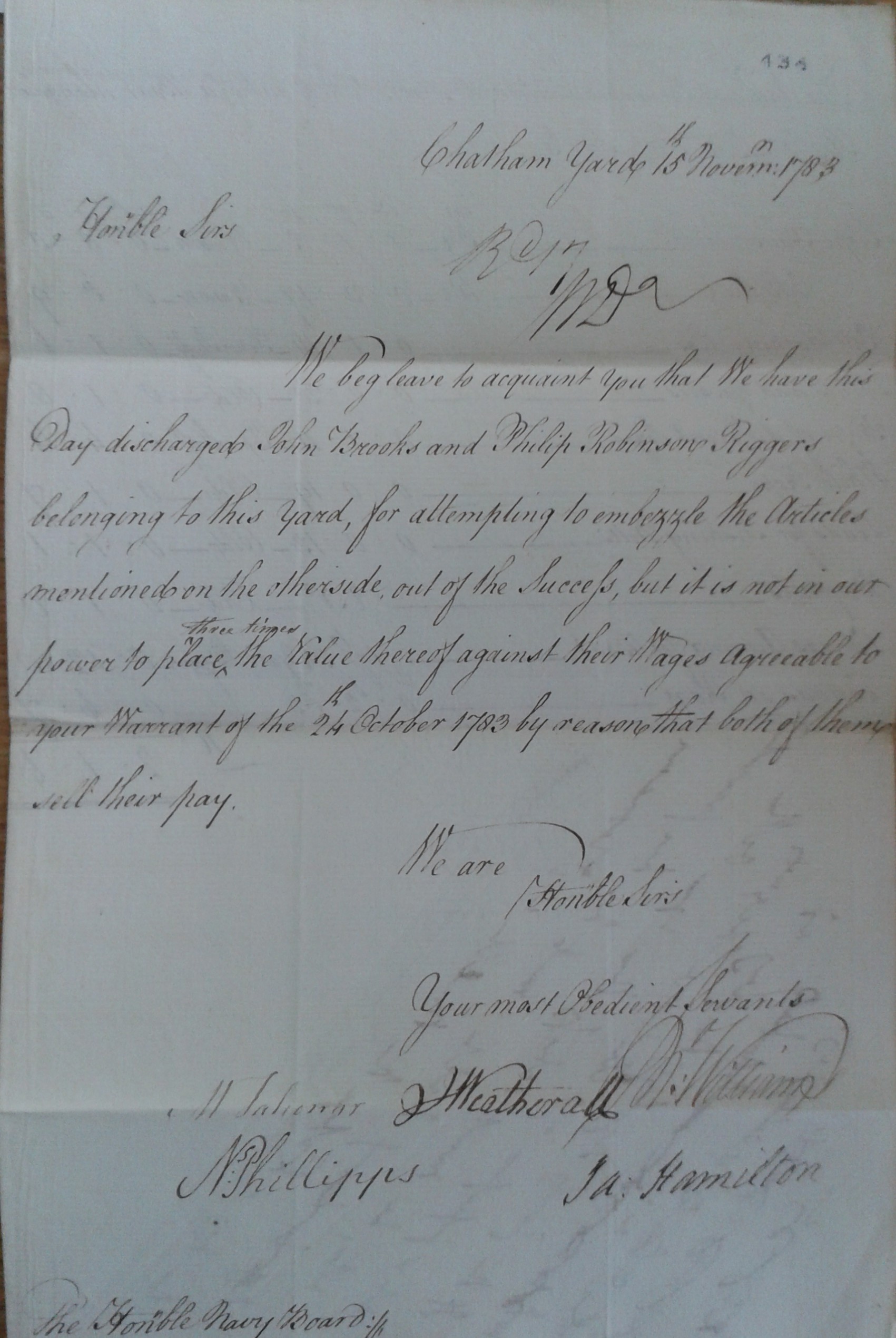
The day’s only faint sliver of hope was a letter
letter

Coming out of Chatham Dockyard on 15th November 1783 it says:

 “We beg leave to acquaint you that we have this day discharged John Brooks and Philip Robinson, Riggers belonging to this yard, for attempting to embezzle the articles mentioned on the otherside [of the letter] out of the Success [a ship], but it is not in our power to place three times the value thereof against their wages agreeable to your warrant of 24th October 1783 by reason that both of them sell(?) their pay…”

Which allows the ever so slight possibility that if this is our Philip (born c.1747), known to be resident in the Chatham area at that time, he may have come to Kent from elsewhere, perhaps even through the Navy. Not that it is possible to prove any link yet, there is no clue as to who his parents were as they are not mentioned on anything yet found. But it’s something and it means the day was not a complete washout.

Robinson update – another Adelaide

While I was away for a few days an email has dropped into my inbox. We’ve had a contact from a descendent of James Robinson, brother of Robert and the one who didn’t go to South Africa at the last minute. I had conjectured that the death of their father just prior to the scheduled departure date had prompted James to remain behind. However, there appears to have been an even more compelling reason not to go in that James’ wife, Charlotte (née Leathes) was seriously ill and died in March 1820.
James remarried and had another child, Adelaide, from whom my new contact is descended. More details when I have them.