[I sense by now mum is losing enthusiasm for the task I set her as her narrative somewhat peters out]
“In 1972 Colin’s mother died and his dad came over & spent a month with us, interrupted by a cruise up the coast of Norway, where he met the awful Marilyn, his second wife. We had a lovely time with him & showed him a lot of the S. East of England. He particularly liked the Brighton Pavilion (when a few years later we took Marilyn there she was very unimpressed). It was lovely to really get to know him & for the kids to at least meet one grandparent.
So Ric wouldn’t have to share a bedroom with Michael, Colin extended the cupboard at the top of the stairs into a very compact cabin style bedroom for him. We had another run-in with the librarian neighbours as they thought the building noise would only last two days, not the two weeks it actually took. They really didn’t approve of us, but didn’t think about their own actions – practising scales (badly) on the piano at 6am wasn’t exactly neighbour friendly either.
There was a very large field diagonally across from our house. At the top of this led onto a wide path to the next housing estate. Our kids were allowed to play on the field but not go onto the path. They always wondered how I knew when they’d done this but as I could see the whole field from Michael’s bedroom window and I also dressed them in bright red jumpers, it was easy to check up on them while I was doing the housework.”
Apartfrom a paragraph about my first teacher, this is where mum’s autobiography ends. I’ve lived in Portsmouth for over forty years now but I’ll do my best to summarise the rest of mum’s story.
Late in 1972 [I think, the 8th December rings a bell] we moved from Rayleigh to Maylandsea on the Dengie peninsular and a branch of the Blackwater River, still in Essex. It was a largish chalet style house down a pot-holed road (that would occasionally take delivery of a lorry of tarmac for everyone on the street to muck in and fill. A temporary fix that would last a few months before all the holes reappeared). Being so far out in the countryside meant we had to bus into school, first to Latchingdon CofE Primary a few miles away where mum also took a job as a dinner lady, having more than one run-in with the eccentric headmaster, Mr Brown, and Mrs Brown his deputy and wife. After about 21 months there I moved on to senior school which meant bussing to Chelmsford, some 18 miles away, because mum could not countenance the idea of us going to the much, much nearer Burnham on Crouch comprehensive. This, for me, involved taking the 11+ exam and acing it to get a choice of schools. It also meant that after-school and other extra-curricular activities were virtually impossible as mum didn’t yet drive and dad was away working a lot. On the other hand we did get involved in 1st Maylandsea Sea Scouts and had many adventures on the water and camping around the county and further afield; from Derbyshire to Andorra and the Black Forest (in winter!).
When I was eighteen and eventually found a place at Portsmouth Polytechnic and moved to the south coast; my family moved to Norfolk (rude). They found a nice house in Hemsby village and proceeded to make it very nice and lived comfortably there for a number of years before they fell victim to the endowment mortgage crisis and had to downsize considerably. They found a small, prefab style bungalow nearby and again made the best of it. Mum’s gardening skills adapted from a large lawned affair to one of principally containers and after losing both Trudi and Domino found great joy in a rescued Irish Terrier called Simpson who slept in an outside kennel and was as daft as the proverbial brush. They became firm Norwich City fans and held season tickets for many years enjoying the many highs and lows of supporting a team that would often yo-yo between divisions and the occasional “club night” in Delia’s restaurant. By now both Michael and I had children and grandparenthood was something they both loved too. Something else they enjoyed immensely was cruising, visiting many places around the world; from Alaska to Argentina, China to the Caribbean, and also closer to home. Consequently we have many photos of “Nana on a bench” from all corners of the globe!
In the late 1980s, before they took to the cruise ship life, they bought a dilapidated old farmhouse in the Mayenne (south of Normandy) in France and spent many years, often going out at Easter, summer and autumn half term, slowly fixing it up with a view eventually to letting it out. It didn’t quite work out that way but we had several free holidays in return for our labour and many adventures in the bricolage before it was eventually finished and they decided to sell up instead of letting as planned. Quite what the new owners made of all the English electrics we’ll never know.
In 1996 mum planned a surprise trip to the relatively new Disneyland Paris to treat the big kid that was my dad for his sixtieth birthday. In return, a year later he tried to outdo mum and took us all to Lapland for the day – the day before Christmas Eve – for her sixtieth, leaving her intricate plans for us all to stay for Christmas in disarray. It was quite the experience though.
In 2015 a surprise revelation from dad during a conversation with friends ended up with them moving to the Isle of Wight that September. Mum remained convinced that he initiated the move so they could be closer to Sarah & me in Portsmouth, as he knew his prostate cancer was slowly bringing his days to an end (he died in April 2018). Mum had ten years on the island altogether and enjoyed it very much, making new friends and being far more active than she had been latterly in Norfolk.
Before I carry on with mum’s story, I just want to draw your attention, gentle reader, to this opening sentence: “My parents met on a Union Castle ship sailing from Durban to Cape Town”. It takes a maximum of four days to sail between those two cities, that’s all the time they had to meet, fall in love and agree to at least the possibility of marriage. The next time they saw each other I’m fairly certain was in London the next year as they prepared for their wedding. Talk about lucky to be here.
On with the story:
“My parents had now moved to Lake Pleasant Hotel which they leased. This was on the shores of a lake halfway between Knysna and George. My bedroom window opened onto the flat roof of the dining room & lounge and I used to climb out there to read. We had six rowing boats and a small pier onto the lake and I soon learnt to row and used to love rowing to the middle of the lake, dropping anchor (a rock on a rope) & dive in. Once however I had to climb back in quickly as there was a snake in the water. I killed it by bashing it against the anchor with an oar & when I showed someone my trophy they said I was very lucky as it was deadly. I also swam across the lake (about 1/4 mile) un accompanied. Health & safety didn’t exist then, although I think my dad was watching from the shore.
The hotel was also about 3/4 mile from a lovely private beach, but I only went there when I could scrounge a lift from one of the guests as it was a very hot dry walk over the hills. We had the same guest come back year after year – the Dickens family with four boys & the two Anderson boys were particular favourites and hanging out with them encouraged me to be a real tom-boy. My mother preferred to dress me in pretty frocks but I lived in shorts and after a major rebellion got her to buy me a pair of jeans & the frock stayed in the cupboard.
At one stage I was a favourite with some of the old ladies who stayed in the winter, and played gin rummy with them. When my mother discovered I was winning small amounts of money most days, she put a stop to it!! I also used to sneak round at Christmas & New Year taking sips from all the glasses – again till my mother noticed. I learnt to like oysters from one guest, Jane ( a widow from Cape Town who I spent weekends with when I went to college in Cape Town) and rollmops from a Dutch family who I also visited in Cape Town.
I enjoyed my school work and was particularly good at maths and English. I shared the prize for maths in my final year but should have won it outright as we had had an old lady supply teacher for two terms of my final year. She couldn’t cope with the syllabus & I used to teach her to teach the class!
When it came to post school education, the same argument arose between my mother and my teachers. They wanted me to go to Cape Town University & study advanced maths & calculus and she wanted me to do domestic subjects. She sort of won & I landed up at Cape Town Technical College taking bookkeeping, typing, shorthand, dressmaking and cooking.
While we lived at Lake Pleasant I used to travel to and from school by train – a whole host of school girls & boys let loose for, in my case 18 hours, with no supervision!! We were very repressed by today’s standards; no drinking, sex etc, but thoroughly enjoyed ourselves. It was about the only time we had to get to know boys from our brother school & work on finding partners for the annual 6th form dance. We did sit opposite the boys contingent in church but the staff were very vigilant but sometimes missed the odd note being passed. I was told I had a ‘very sweet and friendly smile’ – not that it got me a prtner for the dance.
Cape Town
I thoroughly enjoyed being at college – we lived in a hostel on the lower slopes of Table Mountain and had a long walk every morning to the college in town. We passed the still fabulous Mount Nelson Hotel, through the park known as the Gardens & past the legislative house of SA parliament at the top of Adderley Street. The first girl I shared a room with was a very heavy smoker and I tried desperately to join in but couldn’t cope with it or the smell, so asked to change rooms and landed up with an Afrikaans girl from the veldt who used cheap perfume to cover up rampant B.O. I don’t know which was worse.
I joined the hockey team and we used to travel all round Cape Town & its suburbs on our thumbs. We travelled ingroups of three with our sticks at the ready in case of trouble & I was usually made to sit in front to chat to the driver. Once we got in with a very drunk man & I was steering while he kept trying to chat up the blond in the back. We were very glad when we got to our destination. Some of us when the summer came round used to hitch over the gap in the mountain to a beach called Camps Bay. We once went to a guy’s flat and had a lovely lunch & quickly departed leaving his hopes unrealised.
During my time in Cape Town my parents left Lake Pleasant, having lost quite a bit of the little money they gad, as trade was very seasonal& mainly school holidays. They first stayed in a B&B in Port Elizabeth then had three months in a grotty hotel in a grotty strip village called Swartkops. It really had nothing to recommend it. There was a railway station, a road, a hotel, a power station (more later) and a few houses. When I left college I travelled back to PE by boat. It was a three day trip and we had a terrific time. I joined my parents in the B&B and then they moved to Swartkops. My mother, again without consulting me, arranged a job for me as an office junior in her solicitor’s office – Joubert, Galpin & Searle. I don’t think Joubert existed then, Galpin was her solicitor – a grey sort of man, and Searle was a larger than life character who drove an enormous pale blue cadillac. His son also worked in the firm. I used to walk to the bank each morning with a lot of money in a canvas bag. Unknown to me at the time I started on the first floor, Colin worked for a firm of quantity surveyors on the 8th (top) floor. I discovered in 1979, twenty three years later, that I had been offered an Articled Clerkship in a firm of auditors and my mother had turned it down as “women didn’t need careers”. She was at least consistent over the years, but I often wondered what life would have been like if she had been more in tune with my talents.
When I moved back to PE I rekindled a friendship with one of the local girls from my school days – Colleen Foster. Her parents Ken & Ivy always welcomed me to their home. They were staunch methodists & Ivy was determined to both get me involved with the church, and to give me a better social life than I had in Swartkops. She organised for me to go to an Easter camp run by all the methodist churches in the area. This was held on a farm in the countryside near Grahamstown. The coach/transport was due to pick me up in Swartskops but never materialised. It turned out Ivy had given me the wrong time so between her and my dad it was arranged for him to drive me there. This at lunchtime I made a grand entrance and was put into the group headed by Colin. Ivy forever after claimed responsibility for our marriage! I had great fun at the camp and until we moved back from Swartkops to PE (about 5 miles) I used to spend weekends at the Fosters so I could join the group. Once they arranged a trip to the aforementioned power station where I failed to understand how they could wash air! Collin remembers me arguing with the technician.
My parents then found a better job running an ex-servicemen’s club called the M.O.T.H. Club (MOTH being Member of the Order of Tin Hats). We had a lovely flat above the club premises but ass ladies weren’t allowed to be members, my mother and I had to be seen (occasionally) but not heard! These years between college and marriage (31/2 years) were the only ones I actually lived with my dad full time because of the war & boarding school, but I always got on with him better than my mother. After a few months Colin broke up with his then girlfriend, (Katy Aspinall) who was in close cahoots with his mother, and asked me out. There was a direct bus route from near our flat to the top of his road (and to the Methodist church where we went to guild meetings) and that was very handy. Colin would take me home and then sprint for the last bus. If he missed it it was a long walk home.
After a year in the solicitor’s office I was head-hunted to join the staff at a new building society opening across the road and I became a b. society cashier. I loved this work dealing with figures, money, and the public and stayed there for three years. My boss (the head-hunter) was then transferred to our Durban office. Colin and I got married and moved into an annexe in Doncaster Road, Port Elizabeth. Colin’s mother & I never got on, and this made visiting his house quite an ordeal, but his dad was lovely & Wanda [sister] also welcomed me.
Before I married my mother and I used to watch all the cricket test matches played in PE. After 4pm it was 1/- to enter and I would go straight from work and meet her there. We watched all the great cricketers of the day. While I was in Cape Town some of us had gone to a rugby match – the Springboks against the touring British Lions – and queued up outside the dressing rooms for autographs – one of the girls cheekily asked if we could have a lift back into Cape Town as we didn’t want to hitch in the dark, so we rode home in style in the Lions’ coach.
At the end of 1959 Colin’s articles were ending and with no promise of work at his firm, he found another job in Durban where he could also complete his university course. I contacted my old boss, Mr Kilpin, and he arranged a job for me at the Natal Building Society in Durban and we moved into a small flat in Springfield Crescent. We also got our first car, and ancient Hillman. Durban is a sub-tropical city and we found it very hot in the city and after six months moved out to a coastal area where we had a lovely first floor flat & got our first dachshund puppy, Mitzi. I was promoted at work and became a cashier which was the sought after job, but there was a problem. A week before we married I had been hit on my right leg by a hockey ball. This was an inter-guild mixed sex match and one of the guys got the direct hit. I had an enormous lump on my shin (luckily skirts were long enough to cover it), then when we moved to Durban, I was standing on a bollard in the harbour when it was switched on and I slid down the side bumping the same shin again and again. Thus when I got the cashiers job and had to stand all day, I got awful pains in that leg. The doctor thought I had bone cancer & we were very relieved that it was varicose veins. He gave me the advice to never stand when I could sit & to always sit with my feet up when I could. Following this advice, I’ve never had any real problems with v. veins, but thought it would end my chances as cashier. However, the building society bosses decided that rather than lose me they would provide all six cashiers with stools. At first this didn’t go down well with the others who were all a lot older than me, but after a week it was impossible to get them off the stools!
In February 1961 South Africa converted to decimal currency. In those days it was done by hand & on adding machines. Converting each account to the new currency and then checking through miles of adding machine print-outs in case of mistakes, we worked through to 1 or 2am & luckily one off the staff lived down the road from me & gave me a lift home.
Time for another pause before a move to Johannesburg and my own entrance to the story…
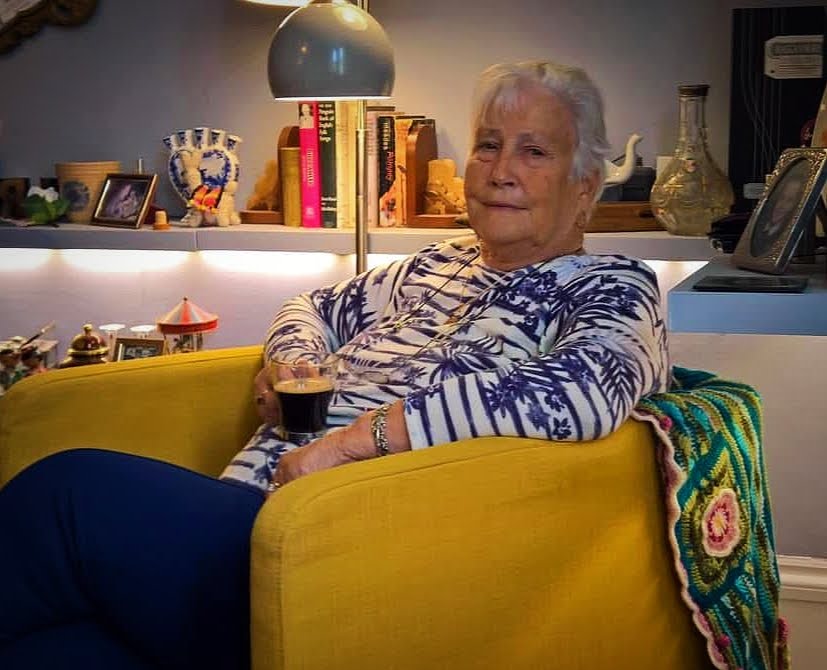
My mum died last week so I thought it was time to tell her story.
Some time ago I asked my parents to write a short autobiography so their memories might not be completely lost once they had gone Dad sent over a shortish Word document which forms the basis of this page, while mum got hold of a decent sized notebook and wrote out the story of her life longhand. I am going to transcribe that story here (with one or two minor edits for privacy’s sake). It will take several posts as she really got into her stride writing it!
Part One – Early years
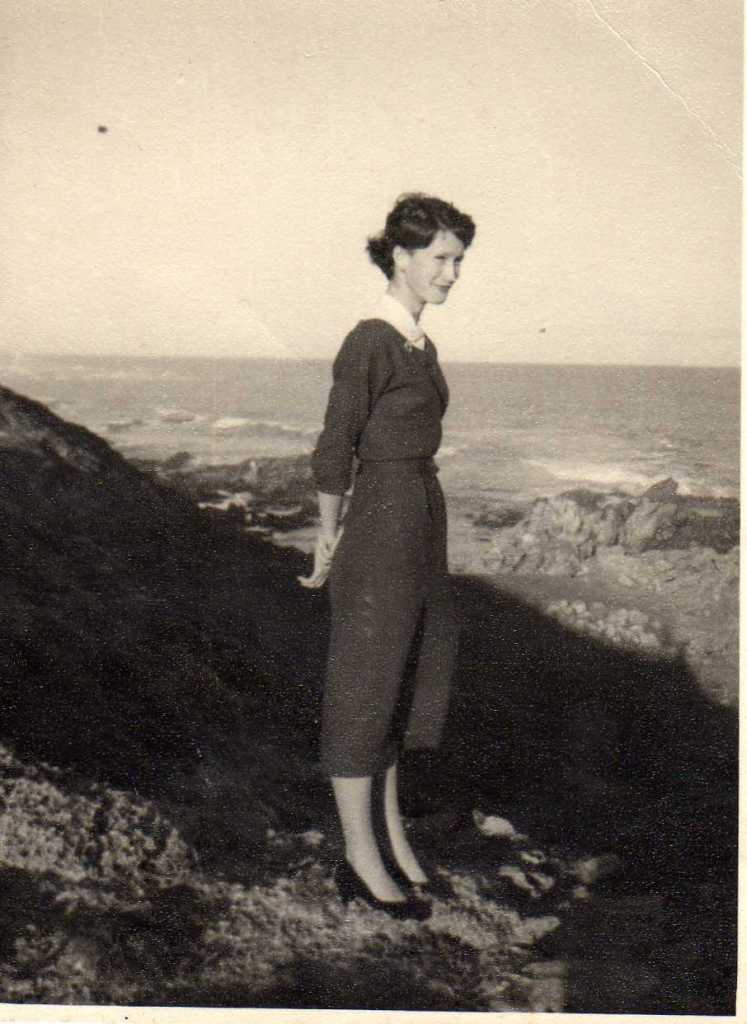
“My parents met on a Union Castle ship sailing from Durban to Cape Town. My dad was returning to England after working in Beira, Mozambique, for the Cable & Wireless Co., and my mum was on a pleasure trip from Durban with some girl friends in 1930/31. They married at St Columba’s Presbyterian church London on 10th August 1932. My brother, Barry John, was still born in Sept/Oct 1936 and I was born at ‘Kloof’, 246 Avondale Ave, Hinchley Wood on 25.12.1937 at 10.17am.
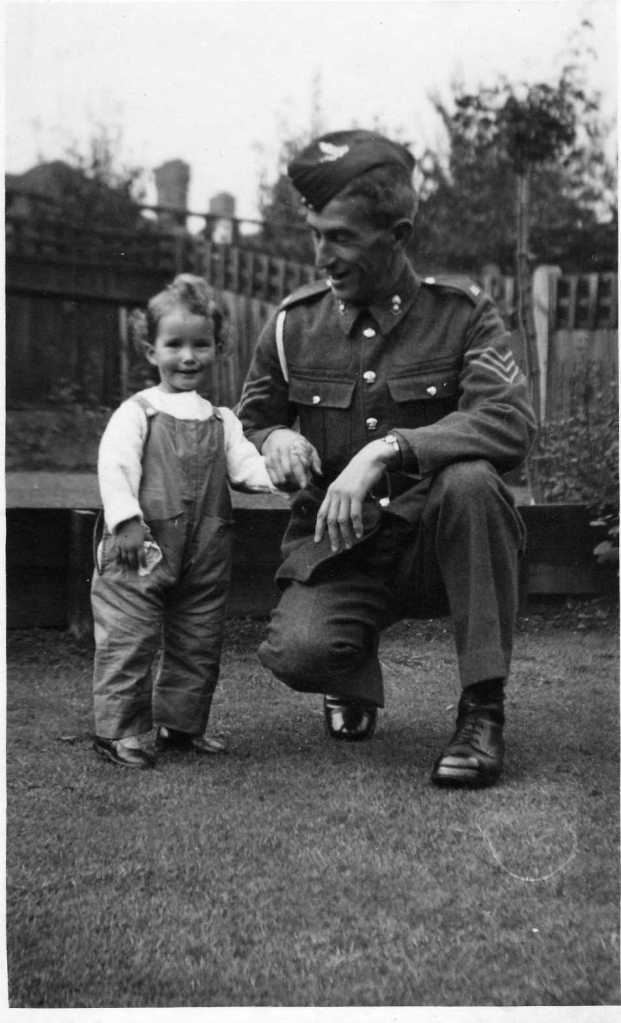
My dad was in the Territorial Army and was called up in 1938, so until he was demobbed in 1946 I hardly saw him (more later). My maternal grandfather died soon after my parents wedding in 1932 and my grandmother made her home with my parents in between her travels and died in our back bedroom in 1942. I used to have nightmares about her quilt which I think was yellow with small flowers on it. (My earliest memory?) as my mother tried to put it on my bed – I wouldn’t have it.
I can remember quite a lot about living at ‘Kloof’. There was a farm at the top of the road with a giant haystack in the field. We loved to play there & were forever being chased off by the farmer. There was also a wide wooded path between the fields with a tiny stream (possibly from a spring) which we used to dam up & play in the thus created pond. “We” were me, Alison Duquid, her younger brother David & two or three others. We were let out after breakfast & had to be home for supper with a packed lunch – summer only of course. When I was old enough for school my mother would walk me through the footpath beside our house & on through to the main A3 road where she handed me over to the senior girls who looked after us on the bus to Esher. The school was divided into boys & girls and had a stove in the corner of our classroom. There was a high wall between the boys & girls play-grounds. I can remember singing lessons – “O, for the wings of a dove”! The senior girls used to walk us home from the bus.
I don’t remember much about the war although I was scared of the noise of the air-raid sirens & for a long time afterwards – even as late as 5-10 years ago I would flinch when I heard the noise of one. We had a large metal-topped shelter in our front room with mesh sides & I think we would often sleep in it – especially when the doodlebugs were coming over. I saw a house lower down the avenue which was demolished by one of these & it scared me a bit. I have also a very clear memory of seeing a plane spiralling to earth with smoke coming out of it. We didn’t do too badly for nourishment during the war as my dad had started a large vegetable garden before the war, and a chicken run, both of which my mother kept going. We also had some food parcels from relatives in South Africa & Australia. I remember nicking a fingerful of what I thought was chocolate spread only to discover the awful taste of Vegemite – I got the hairbrush on my backside to add insult to injury!
My mother who hated living in England was trapped there by the war. Remember she grew up learning to manage a household with servants & then had to do everything herself. On top of the housework she had the vegetable garden, chickens & had to nurse my grandmother through her final illness, so in 1942 she had a breakdown & we were sent down to Abbots Ann near Andover for a few weeks so she could recover. It was a lovely old water mill which had been converted & the mill stream still ran under the living room floor. The relative we stayed with was one of those gruff, no nonsense women who I still remember with affection although I can’t remember her name. While we were there, my mother had sleeping pills & I helped myself to one or two thinking they were sweets. I can remember being kept awake and walked up and down the living room all night! We didn’t stay long as my mother didn’t like leaving the house unoccupied. She also belonged to some organisation which provided some home comforts for Australian & South African service personnel, who would come for a meal & sing-song etc round the piano in the front room. They also gave us some of their rations in return.
On VE Day we went up to London to see the celebrations and I can remember being picked up by some sailors & put on top of aa wall (part of a bomb site) so I could get a better view – but I can’t remember what I saw!
Towards the end of the war & during 1946 mum & I used to travel by train from home via Waterloo to visit Aunt Peggy in Sidcup. She was having trouble coping with 2 children while Bill was away with the forces. Jim was older and quite a help, but Eve was a real handful. We’d take her eggs & veg from the garden and exchange our veg for something different they’d grown. I used to love Waterloo & tried to escape my mother whenever I could – but she always knew where to find me – riding the escalators!! I was only 6-8, but was very good at escape!
In 1946 we had some Australian friends (relations?) come to visit. They had two obnoxious boys, dressed in what to us were incongruous uniforms, who plagued the life out of me behind the adults backs! I eventually snapped and pushed them into a big nettle patch. Needless to say I got a lecture on hospitality and the inevitable hairbrush! My dad was stationed with the Royal Artillery somewhere in North London but was very lucky and missed being sent overseas twice through being in hospital. D-Day he missed through a hernia op, but then in 1946 before being demobbed he was sent to either Kenya or Ethiopia for a short period. He was demobbed in the middle of the year. He got home and my mother pushed him into emigrating to S. Africa. She’d not liked the cold in England, and the shortages etc of the war years were the last straw. He was rather silly to leave his job at C&W as he only had 9 more years before his pension & he lost all that. However this decision was made & in December 1946 our house and contents were auctioned off – I vaguely remember this. We stayed in a hotel in Northumberland Avenue, just behind the S. African embassy where we pent a few days waiting for our final papers. Most of my toys (such as they were after the war) were in the auction, a few were crated up & shipped to Port Elizabeth S.A. and I kept a small doll, her clothes & a couple of books with me in a small attaché case. The day wee left London this was stolen, and most o the toys sent by sea were ruined as the crates were left on the fish dock at P.E. before they were found and returned to us.
We left England on 21.12.46 from Croydon Airport (before the days of Heathrow) and flew to Brussels where we spent 36 hours waiting for a Sabena Airways flight to Africa. I can remember that the hotel had a corridor/reception opening on to a street at each end, & it had a red carpet. It seemed very grand to me – but I suppose that immediately post-war it was probably very shabby.
23rd December we flew to Tripoli in Libya and then flew overnight to Kano in northern Nigeria where we stopped for breakfast and refuelling. I can remember flat roofed, sand coloured buildings & loads of lizards.
24th December we flew from Kano to Leopoldville in northern Congo [now Kinshasa in DRC] & stayed in a pretty hotel with lush gardens – on Christmas morning I had a very small stocking with fruit and an elephant hair and gold bracelet purchased locally. There wasn’t much time to enjoy Christmas as we then flew on to Elizabethville [now Lubumbashi in DRC] where we again spent the night.
26th December we left the Congo & flew down to Rhodesia (either N or South) [Malawi/Zimbabwe] where we touched down for a mail drop & refreshing glasses of fruit juice. We landed in Johannesburg in the afternoon where we were met by Janet Paton and family. She was a school friend of my mother. Her son Hugh was horrible. We then caught the train down to P. Elizabeth & booked into the Balmoral Hotel in Western Road. The next two weeks were busy kitting me out for life in boarding school. The reason for going to PE was because my mother wanted me to go to her old school, Collegiate, which in S Africa was just about on a par with Roedean or Benedon in England. The junior boarding house was a very large bungalow overlooking St George’s Park, called Nahoon. It was owned and run by Mrs McKenzie who lived in the front, and we had the back; two dormitories, dining room, kitchen, sick by & matron’s (Miss Mellor) bedroom & office. There was a long driveway with a pergola over a large back garden. We used to rollerskate down the drive, jump up & swing from the pergola until someone broke her ankle and it was banned. When I started there I was the little waif from wartime England among a crowd of rich farmer’s daughters from the inland veldt. I was completely different and had no experiences in common with the other girls. My mother had made me some very pretty viyella nighties with Peter Pan collars & puff sleeves which caused great amusement to the pyjama clad occupants of my dormitory, and until the prefects put a stop to it, there was a nightly ritual of making me stand on my head! The staff at the hostel also couldn’t understand why I had trouble drinking the full cream milk served up to us. It was so rich it made me gag as I was used to the very thin milk we had during the rationing period. Consequently I still can’t drink a glass of milk.
My parents found work running a hotel right on the beach at a place called Keurboomstrand (beach of the Keur tree) which was on the “Garden Route” near to Plettenburg Bay, about 250miles from PE. It was a rickety old wooden structure set on the edge of a small village. The whole place was later (after 1965) taken over by the military & doesn’t exist any more. We tried to visit it in 1989 but the road was all overgrown and big locked gates stopped our entry. A pity because the beach was superb. In 1948 there was an outbreak of scarlet fever and we were all swabbed to see if we were carriers. I was, as well as two sisters from the country. They were allowed to go home after a few days as they lived on a farm, but as my parents had a hotel, I was incarcerated in the sick-bay for three weeks. I had no contact with the other boarders – the matron was the only person I saw, and that only briefly to bring my meals, check my temperature etc. I had a radio & could go into the garden while the others were at school, and got given one book – “Daddy Longlegs” – grudgingly as it had to be fumigated after me. They wouldn’t believe I could read it in one day and I was told not to be a liar. After lengthy discussions between teh hostel, doctors & the parents of the Leppan sisters who also carried the virus, I was allowed to go to their farm for the final few days I had the virus. None of us had contracted the disease thank goodness as that would have meant the Fever Isolation Hospital.
I did well academically and when it came time to to choose my options for high school an almighty row broke out between my mother and my teachers (a recurring theme). She wanted me to do a domestic science course (perhaps because she’d been so unprepared for life in England) and they wanted me to do an academic course. Luckily the teachers (and maybe my dad) prevailed and started high school in 1950 in the academic group. I don’t think I would have coped with the boredom of sewing my white apron, perfect to the nth degree, so I could then learn to wash up and boil potatoes!
The headmistress was called Miss Brock. She was a desiccated spinster who most strongly resembled a long matchstick. She had very pronounced views on what was acceptable out of school clothing for teenage girls and we all had many a run-in with her over this. The first two years, the uniform was very ugly – navy box pleat gym slips in winter and blue fabric gymslips in summer. We had navy blue suits for church in winter and white pleated dresses in summer. None of the above flattered us in the least. For my last two years we had a uniform revamp and were allowed quite flattering styles of dress. The sixth formers were then allowed to wear stud earrings out of uniform and I had a major run-in with Miss B as my studs were wooden, not the pearls she meant! I was often accuse of being “agin the government” as I didn’t like petty rules for rules sake and would write letters of complaint to my mother who would take it up with the school! One such instance was the snack at tea-time. It was meant to be a slice of bread & jam. The bread was spread with white margarine and you could never guess the colour of the jam – let alone the flavour. After many moans, we got slices of madeira cake or similar.
There were two floors of dorms and a separate block for the sixth formers – two of the balconies were used as overspill beds and I was luck y enough to have one of these beds for a year. Most of the time you were out in the open air, but if it rained we had to let down heavy canvas blinds which had along beam of wood to hold them down. They rattles horribly in storms, but we were a hardy lot & only occasionally gave in and let them evacuate us to the dorm floors.
Our sports field was about 3/4 mile away in St George’s Park and now we were seniors we were allowed to walk there unaccompanied. This meant our group used to sneak to one of the girls’ houses (which was next to the field) for tea & cakes. We played hockey and netball in the winter and tennis & swimming in the summer. I played hockey (left half) as I didn’t like netball. In those days hockey was a much rougher game with fewer rules. I couldn’t play tennis as the racquet my mother got me was far too heavy for the strength of my wrists & every time a ball was hit to me, it took the racquet out of my hand. This occasioned contempt from all the farmers daughters who started playing as soon as they could walk. I was fairly good at swimming although I had a late start. My mother’s friend’s husband, Dip Cooper, threw me in the deep end of the pool and watched till I managed to swim. This was days after my ninth birthday. I had no stamina for long swimming events but I was very good at obstacle races – over barrels, under ropes etc and won the prize most years.
This looks like a convenient spot to pause – to be continued…