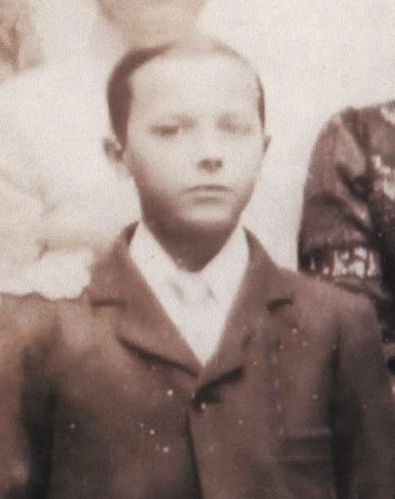
 Late in 1889 William John Ellicott, fourth child and eldest son of William Ellicott, married Sarah Ann Burgoyne, from Ashprington in South Devon. They had three children: Dorothy Annie (1890 – 1978), Bertie William (1892 – 1973) and John Burgoyne, known as Jack, born in January 1894. By 1911, according to the census, Jack was living and working on a farm at Ashprington “learning farming”.
Bertie was living in Wanstead when he was signed up to the London Regiment on 8 April 1916. He survived the war and returned to take over the family farm. Whether Jack volunteered or was called up when conscription was introduced in January 1916 is not known, but at some time he was drafted into the 8th (Service) Battalion of the Devonshire Regiment, a battalion formed 15 days after the outbreak of war in 1914 as part of the New Kitchener Army.
The 8th Devons were part of 20th Division of General Gough’s Fifth Army and was sent to France in July 1915 where they were to be employed in The Battle of Loos. In 1916 They were in action during the Battles of the Somme, including the capture of Mametz, The Battle of Bazentin, the attacks on High Wood, The Battle of Delville Wood, The Battle of Guillemont and the Operations on the Ancre. How much of this involved Jack we don’t yet know.
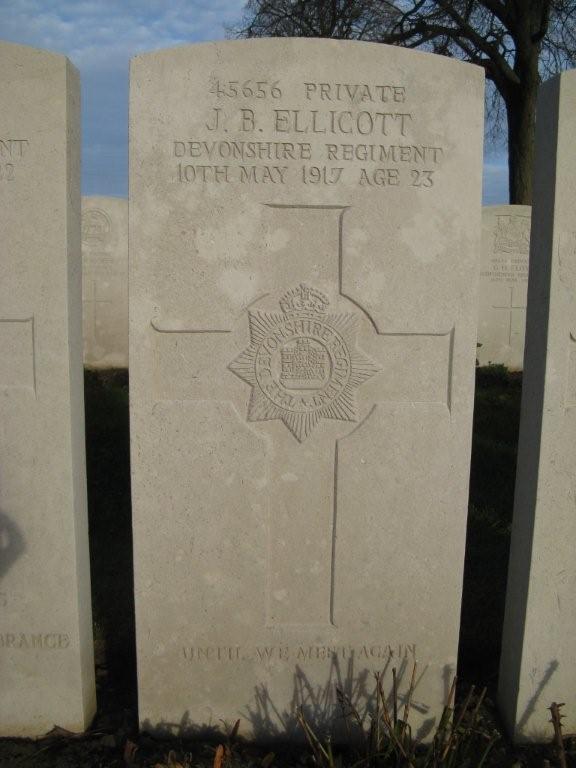
 The battalion was then deployed in a flanking operation, the Battle of Bullecourt, in the Arras Offensive of April – June 1917. During the second Battle of Bullecourt, which lasted for two weeks between 3 – 17 May, Jack Ellicott was fatally wounded. He was transferred from the first aid station to the clearing station at Achiet-le-Grand, where he died on 10 May 1917 aged 23. He is buried in at Achiet-le-Grand Communal Cemetery Extension between two other men of the Devonshire Regiment.
Jack is commemorated on the Morchard Bishop War Memorial in Devon even though his medal card gives the address for his parents as Cobley Farm, Lapford, so why Morchard Bishop and not Lapford, which has its own memorial, is a bit of a mystery.
Jack is my first cousin, twice removed.