Erith’s story

Mocavo have finally proved useful. They have digitised a whole raft of South African journals and official records including several volumes of “Records of the Cape Colony”, among which we find nearly all the correspondence relating to James Erith’s disputes with his party and the colonial government. Erith was the lead member of the party of settlers joined by Robert Robinson and his young family but said party also fell apart with disputes and recriminations soon after landing at Algoa Bay.

It’ll take a while to read and extract the story to tell but it’s quite an exciting development.

Stay tuned.

Charts

I’ve put together (ok, exported from Ancestry) some pedigree charts for my grandparents’ lines. They’re to be found at the foot of the Robinson, Currie, Ellicott and Leith pages in the top menu and I hope they will help make new connections.

Glimmers

Not much, but I found a website detailing some of the descendants of James Robinson, principally through his daughter Adelaide and her marriage to Henry Havill. I’ve emailed the owner in the hope we can exchange a bit of info and I can get a better picture of the Robinson family in Kent.

Still absolutely no sign of the earliest Philip’s birth though.

Quick update – Mary Ann Foster

So far it seems Mary Ann Foster has managed to cross continents unrecorded.

Thanks to some help from Rootschat, I’ve found that at the time of her father’s death in 1898 Mary was living in Cheltenham, a suburb of Melbourne, Victoria. I still believe she was a nurse, but have also discovered she wasn’t trained at the Royal Melbourne Hospital and can still not find her on any list of Australian nurses bound for the Cape.

The next time we know her whereabouts is August 1902 when, presumably because of her impending nuptials, she asked for and received confirmation of her birth record from the Victorian State Statist, Richard Treacey. This shows that she was in South Africa shortly after the conclusion of the Anglo Boer War and, it can be surmised, she hadn’t just arrived if she had got engaged that summer.

So, sometime between 1898 and summer 1902 she crossed the Indian Ocean. There’s a searchable index of passengers leaving Victoria to foreign climes and as far as I can see, she’s not on it. There is a Miss Foster bound for Fremantle and it is possible that she travelled there first (her sister Matilda was married and living in Perth) which is great, but passenger lists for those leaving Western Australia are not so easily found. Update: I found the arrival manifest which has been digitised on the WA archives site, and while the Victoria archive suggests a Miss M Foster left Melbourne on the Wollowra, she’s not listed when it gets to Fremantle. So frustrating.

Noticing things

It’s funny what you notice when you’re not really looking.

I’ve been both a bit disheartened after Kew and busy with other things, so haven’t been actively looking for anything in the family history for weeks. However, some time ago I made a list of things I should be doing in this field, one of which was to track down the nursing credentials of Mary Ann Foster. I had another cursory look today and there’s still nothing showing on any of the records of Australian nurses at the Boer War. A bit disappointing but not unexpected.

Anyway, I started to look at it from another angle given that there were a number of nurses who travelled to South Africa from Australia but were not part of any official party. Passenger lists are an obvious option and I was about to start searching for them but then I got distracted. Just going over things known, I was reading the reports of her father’s demise when it struck me that she wasn’t there – the reports only mention her younger sister Margaret and later the husband of her older sibling, Sarah, as pall-bearer. Mary Ann would have been 26 by this time and although still single could, in theory, be anywhere in the world, so the chances that she would show up on any official Australian list of nurses becomes more slight not better. Just the sort of puzzle one needs to kick-start the research juices.

The game is afoot!

Frustrated and a bit disappointed

The trip to Kew turned up very little at all.

The day started brimming with hope even through the remnants of the rush hour traffic. I arrived at 10am, registered for my readers card and started searching. I had a number of references to look at prepared in advance but as you’ll see below they were frustratingly unrevealing. It was also a very long wait for document retrieval, which I wasn’t prepared for. I ended up leaving just after 6pm not much the wiser. It’s a lovely place though, and everyone was very helpful.

I found no sign of Philip Joseph Robinson’s court martial. I looked through four thick ledgers of handwritten records and found nothing. There were also two ledgers in the catalogue listed as “wanting”, meaning they were supposed to be in the archive but somehow hadn’t arrived from the originating body. This didn’t help the growing sense of frustration. Could he have been in them? Probably never know.

There was no sign of Ralph’s East African birth either. If he was born there it was not registered with the British authorities, which still leaves the possibility of PJR being some part, albeit temporary, of the post-war Afrikaner migration and therefore of a Dutch Reformed Church baptism coming to light. More work needs to be done on this.

I could find nothing to add to James Edwards’ met police record. Too much of this record set is missing – there are very few complete service records available and I couldn’t find any correspondence relating to his dismissal.

One of the things I managed to find was the Will of William Robinson. The reason I was looking relates to the 1820 migration to the Cape. Before some of the parties of 1820 Settlers left England bound for South Africa they would meet up, presumably for updates and questions. The Erith Party, of which Robert Robinson was a member, met on Newington Causeway above the Crown and Anchor public house. Another group, curiously, met at Robinson’s Tobacconist on nearby George Street, which has niggled away as possibly being of importance but of which I can find no trace. There was, however, a Robinson’s Tobacconist on Tooley Street, just round the corner, but I now know at least that this was nothing to do with us, which I suppose is a positive of sorts. It’s proprietor was this William Robinson whose only son it turns out was Thomas. Not a Philip to be seen.

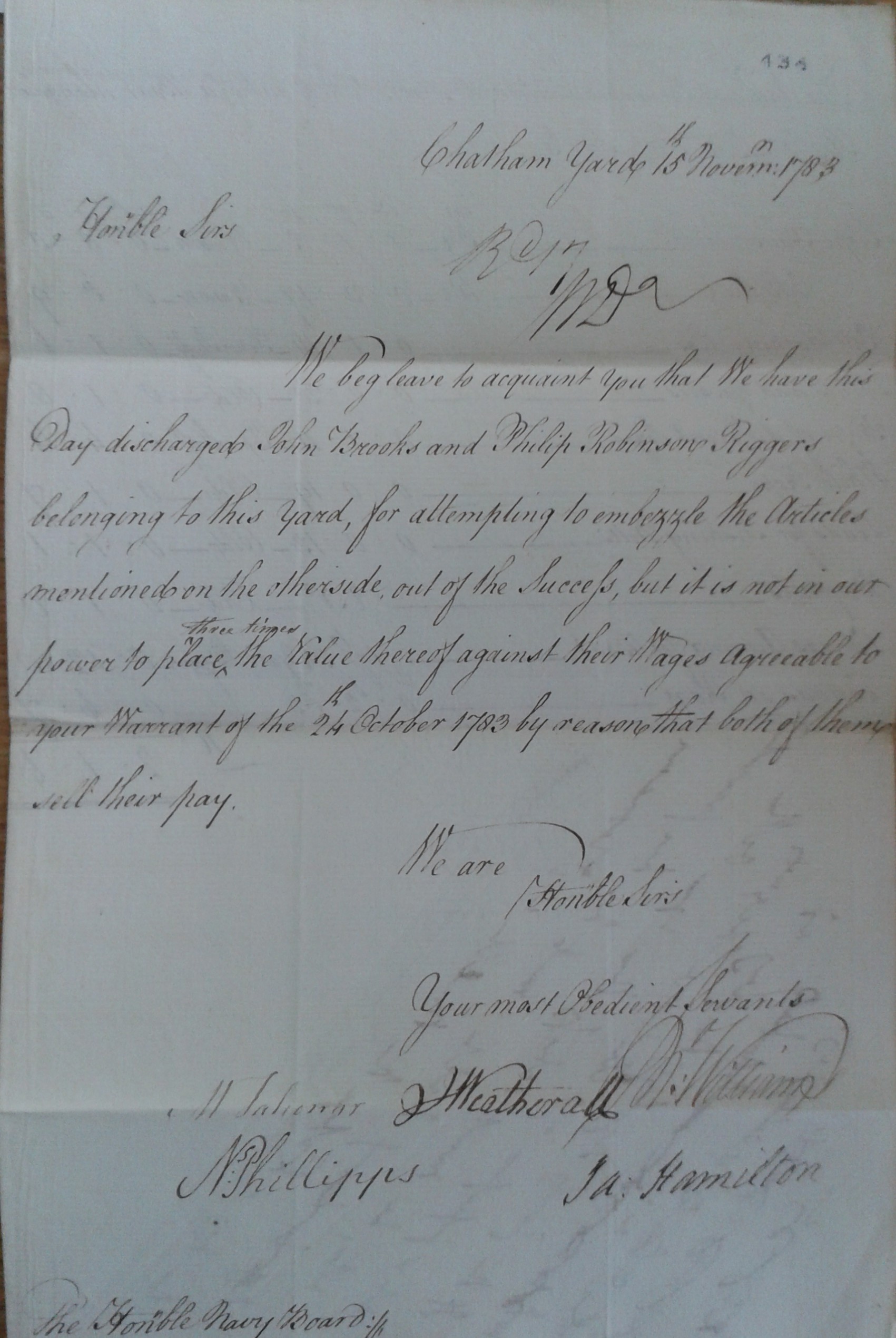
The day’s only faint sliver of hope was a letter
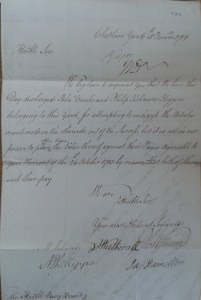
letter

Coming out of Chatham Dockyard on 15th November 1783 it says:

 “We beg leave to acquaint you that we have this day discharged John Brooks and Philip Robinson, Riggers belonging to this yard, for attempting to embezzle the articles mentioned on the otherside [of the letter] out of the Success [a ship], but it is not in our power to place three times the value thereof against their wages agreeable to your warrant of 24th October 1783 by reason that both of them sell(?) their pay…”

Which allows the ever so slight possibility that if this is our Philip (born c.1747), known to be resident in the Chatham area at that time, he may have come to Kent from elsewhere, perhaps even through the Navy. Not that it is possible to prove any link yet, there is no clue as to who his parents were as they are not mentioned on anything yet found. But it’s something and it means the day was not a complete washout.
Getting ready for Kew

National Archives building

It’s been a quiet few days treading water before the big trip to the national archives at Kew on Thursday. I’ve even got some prep done so I know what it is I want to look up while I’m there! I’m going to be looking for potential birth records in British East Africa, records of the Metropolitan Police, Court martial records for the Boer War, and potentially some Wills.

I wonder if it’ll be better or worse for everyone else being at WDYTYA Live starting on Thursday.

Brief update

Many, many searches have been done and many, many document sets have been trawled, all to little avail.

There is still not much to report after weeks of searching for the perennially elusive Philip Joseph Robinson or his wife Louisa Anderson, although there is a family of Andersons from Harrismith that look a promising match without as yet an explicit link back to Louisa.

Having said that, there has actually been some progress around the periphery. A lot more has been found about Ralph Victor Robinson, PJR’s eldest son and my great-uncle. For instance Ralph was married and divorced twice – first to Lauretta Twentyman-Jones and later to Patricia Campbell (née Mayer). Both marriages were short-lived and apparently produced only one child. None of which sheds much light on the main search for his father’s birth and death, except for perhaps the most interesting thing discovered about Ralph, and which I nearly missed.

The marriage register for the wedding of Ralph and Lauretta in Wynberg says that he was born in “East Africa”, which came as a bit of a curve-ball. It means that shortly after Philip and Louisa married in 1903 and before he was employed back at De Beers in Kimberley in 1905 the couple were in British East Africa, presumably taking a chance on what briefly looked like a new land of opportunity. Much more to be discovered and the final push I needed to get up to the archives.

I’m off to Kew on the 16th.

1752 and all that

Just something for the amateur genealogist to remember.

1752, the year Britain and Ireland finally adopted the Gregorian calendar, started on March 25th and ended on December 31st. Not only was the year a short one, officially, but it also “contains” the famous missing eleven days as September 3rd was immediately followed by September 14th.

It’s something to bear in mind when checking those parish registers as prior to 1752 the year effectively ran from April to March and the old records will still show the old way. As an example, someone born in February 1741 to our mind would themselves say they were born in 1740. This can lead to confusion when researching so it is useful to be clear and record these dates as either (in this instance) February 1740 (O.S.) [old style], February 1741 (N.S.) [new style], or double date it thus: February 1740/1 to show we acknowledge the difference for any ancestors born January to March prior to 1753.

In Scotland, although the Julian calendar was still used up until 1752, the New Year changed to January 1st in 1600. Catholic European countries had made the change to the Gregorian calendar as far back as 1582.

Cape Police

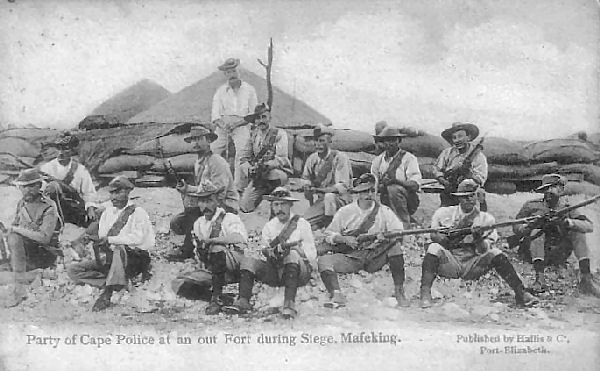
At the start of the war there were some 750 members of the Cape Police. According to angloboerwar.com, a force so ubiquitous, and its services throughout the whole war so varied, that to give a connected account of its work is impossible. This is the unit that Philip Joseph Robinson joined in September 1900 and so must be* among the 14 men pictured in this old photograph of a Cape Police unit at Mafeking.

unit of soldiers

It shows their uniform though and the almost compulsory moustache wearing.

*won’t be