A little more light

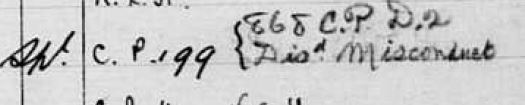
Philip Joseph Robinson it seems did not serve with the Imperial Light Horse, despite saying that he had when completing his Kimberley Horse attestation papers in May 1902. This entry from the nominal rolls has the telling addition of “no trace” above the initials ILH (left hand side).

27c2432ccb7f01b6f31a9df6b7c649f6

But it does at least add to the sum of knowledge so far.

Clearing up anomolies

To mix a metaphor, much of the last few days has been spent chasing a red herring over hill and dale. The report of a will mentioned in this post has to be examined and explained. And now it has been. The will in question refers not to Philip Joseph Robinson of Kimberley but to plain old Philip Robinson of Middleburg.

This is another example of someone taking some shared speculation and passing it on as fact, even embellishing it with middle names and a spouse. Somehow this original communication:

Philip [b4c3] left only tools of trade (£15) and a bicycle (£3) and stated in his Will that should Sir JB Robinson make any bequest to him, it to be equally divided between his son Philip [b4c3d1] and daughter Margaret Elizabeth Botha [born Robinson married to Zeiler Botha], and his grandson Philip Robinson [b4c3d1e1] and all his cattle to his grandson. Sir J.B. Robinson was the uncle of Philip [b4c3] and the brother of Philip [b4].

became this:

He (Philip Robinson) left a will in South Africa; He left only tools of trade (15 Pounds) and a bicycle (3 Pounds) and stated in his Will that should Sir JB Robinson make any bequest to him, it to be equally divided between his son Philip, married to Louisa Anderson, and daughter Margaret Elizabeth, married to Zeiler Botha, and his grandson Philip Benjamin Robinson, and all his cattle to his grandson. Sir JB was his uncle.

As you know if you’ve read the “Where it all began” section, I had made the mistake of thinking that this Philip was my ancestor when he turned out to be a great grand uncle so I suspect I share a portion of the blame for passing on the will and wondering out loud if it did refer to my great grandfather.

What’s the first rule of genealogy? Accept nothing as fact without proof!

exhibit5

New light shed

Finally, a new source for Philip Joseph Robinson that answers more questions than it poses!
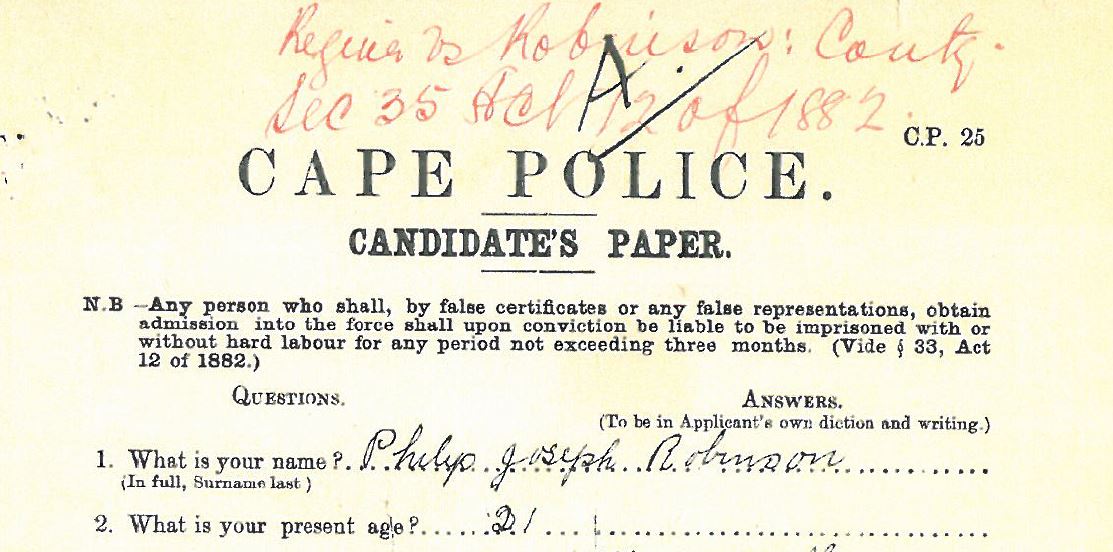
I’ve just been sent the candidate papers for when he signed up to the Cape Police.
PJR-CPI’ve updated his page incorporating the new information, which does throw a deal of new light on his early years at least. He was a butcher but had been working on the railways in the north before the war, could read and write both Dutch and English, and had no indication of venereal disease!

It’s such a good feeling when your new information actually improves your understanding.

A Slippery Fish

The earlier teaser post included this image taken from the medal rolls of the Kimberley Horse.
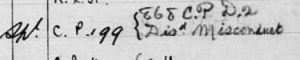
Intriguing

Note the numbers 868 and 199, the apparent numbers assigned to PJ Robinson while serving in the Cape Police.

The full entry shows how any medal supposedly earned for his service in the Anglo-Boer War was not issued (note the crossed out entry):

Exhibita

(and what does “H.O.” mean?)

The initials “P.J.” could be Patrick John for instance, so how do we know that this refers to Philip Joseph Robinson?

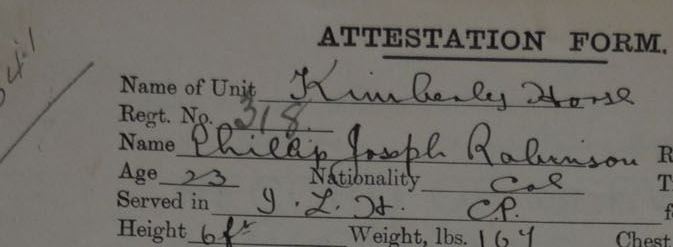
Take a look at this close-up of Philip’s attestation paper for the Kimberley Horse;
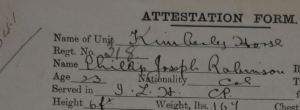
Exhibit1

The important details are; his name (obviously), his regimental number (318, matching the record above) and that he previously served in I.L.H and C.P. vis the Imperial Light Horse and Cape Police.

So far, so good.

I couldn’t find any mention of him in the ILH rolls but did find mention of PJ Robinson in the Cape Police medal rolls (Anglo-Boer War): Here is the name:

exhibit3Again, the number 199 matches that on the Kimberley Horse record, and at the other end of that line is this:
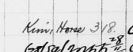
exhibit2
So the two match. 199 Sergeant PJ Robinson of the Cape Police was also 318 Corporal PJ Robinson of the Kimberley Horse.

So who’s this?

exhibit4

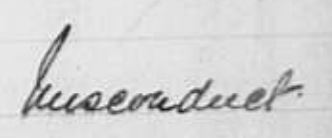
And what did he do?
exhibit5
This is the only other PJ Robinson I have so far found in the Cape Police rolls; Peter Joseph Robinson, but matching number 868 and also discharged for misconduct. Typo? Perhaps a mix up of two different people’s records? Could it even be that the misconduct was giving a false name? At this stage, who knows?

But we do know Philip was prone to a name change…

Phillip Joseph here, Philip Joseph Hercules on his marriage certificate, just Joseph on his wife’s estate papers, no wonder he’s proving difficult to pin down!

A brush with minor royalty

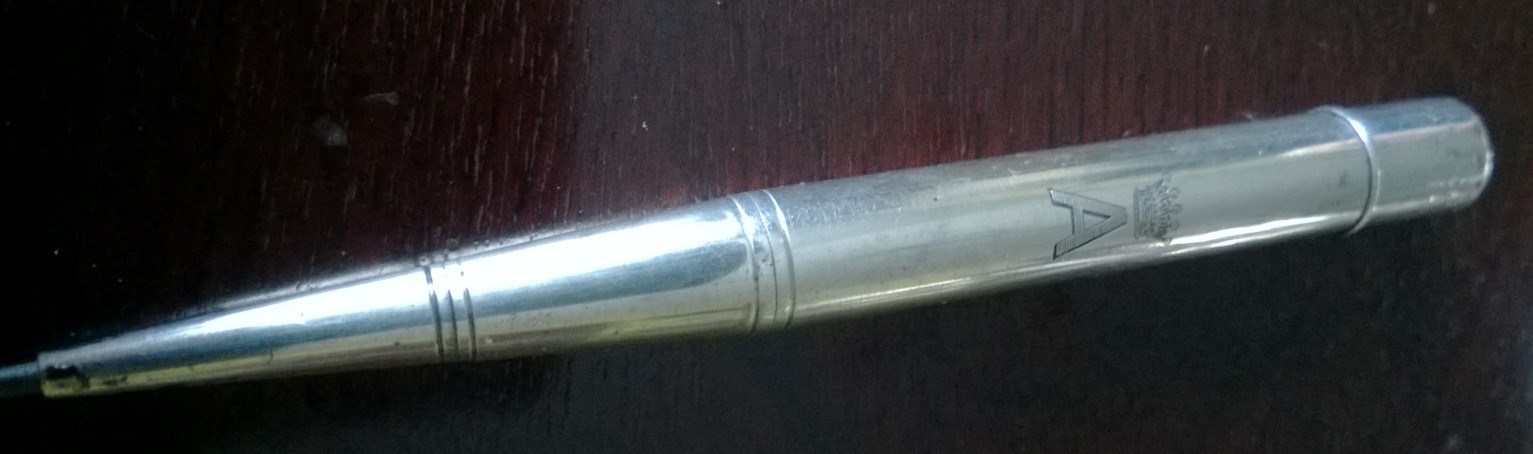
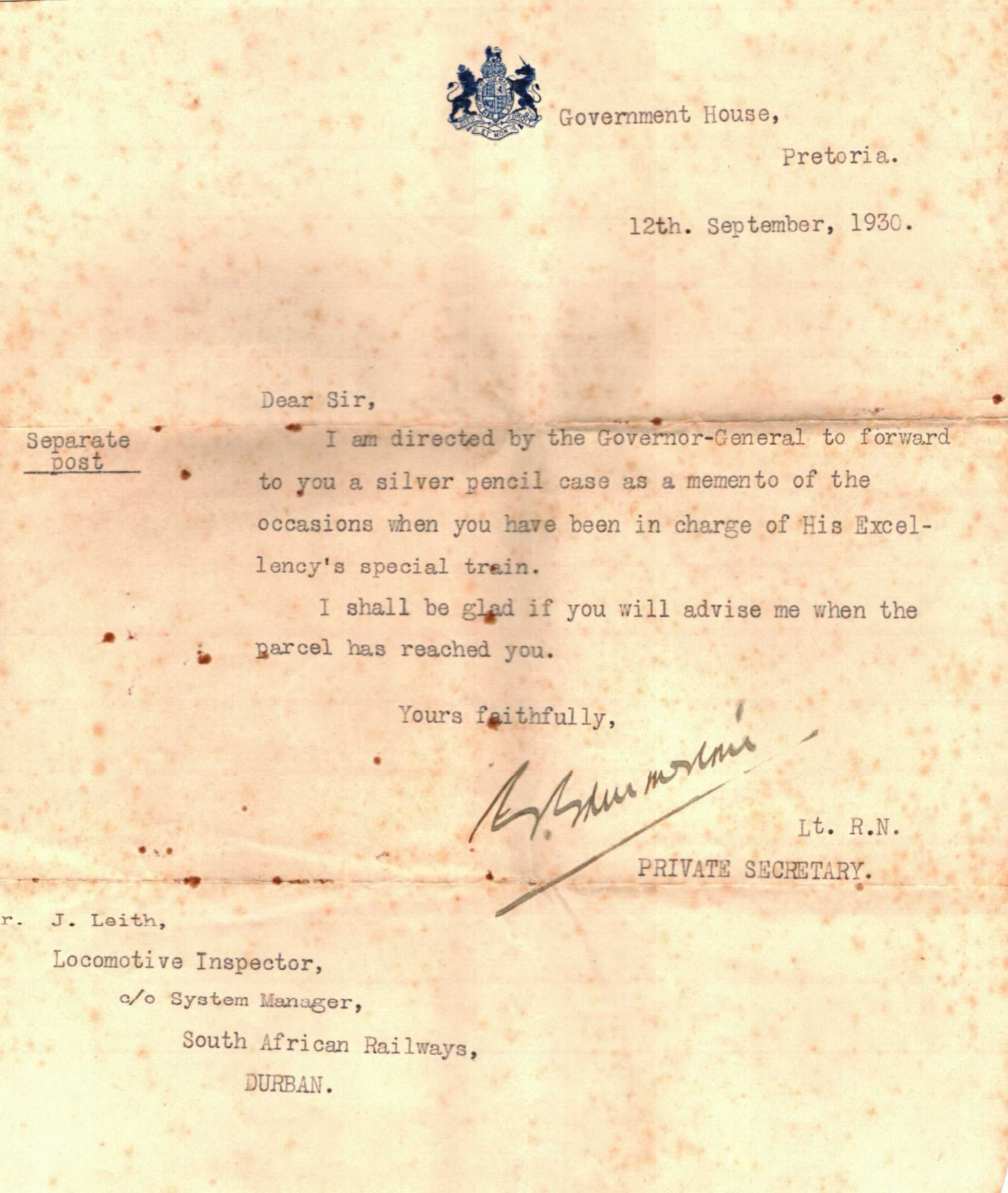
Much as I am vehemently against inherited privilege, my great-grandfather, John Leith, would have been chuffed to receive this gift from the then Governor-General of the Union of South Africa (the Earl of Athlone and husband of Princess Alice, granddaughter of Queen Victoria), on his retirement from the railways.

pencil

As the following letter shows, John was in charge of the train that the Governor-General often used to travel around the country on his frequent ceremonial tours.

letter

Worms

Sometimes it seems that tracing your ancestors is like picking your way through a minefield populated by explosive cans of worms. When you know there are people out there still believing outdated and disproved relationships, it’s hard to keep track of what’s right and any help you get has to be weaned off the error-strewn trees of others. You try so very hard to accept the basic facts you have without further embellishment, trying not to care that you don’t know the exact date of someone’s death, or even birth, but you can’t. You have to pull at the thread.

So it was when once again I turned to the yawning gap in the family tree; my only incomplete great grandparents, Philip Joseph Robinson and Louisa Johanna Anderson. Pick, pick, pick. I know one day that Philip’s death record will come to light as it must have happened in the latter third of the twentieth century, and also that sooner or later someone will find and digitise his baptism record if it still exists. But, regardless, we know the basics. He was born in Kimberley in 1878 to Andrew Joseph Robinson and Sarah Vercuil, married Louisa Anderson in Harrismith in 1903 and had six children before she died in 1920. Despite the odd missing document, the Robinson line is there.

Louisa on the other hand, remains a mystery. We know from her death notice that her parents were Ralph and Pauline and from her marriage that she was born around October 1884 in Harrismith. And that’s about it. Widening the search proves fruitless. There are no Ralph and Pauline Andersons to be found anywhere, no sibling Andersons with the same or similar sounding parents, no baptismal record for Louisa.

The trouble is, in searching for Louisa again, other long-forgotten leads are brought once more into the light. And these snippets of information, however vague, can set off those worm bombs. For instance there is a report of a Will that in one version indicates a bequest from Philip to son Philip and Louisa and also to grandson Philip Benjamin – South Africa records seem plagued by inconsistent record-keeping, bad handwriting and poor transcriptions so I suspect mistakes and assumptions have been made and that this applies to a different Philip altogether, but the actual Will now needs checking. And the worms are loose.

Then, just to get things clear in my head once again, I summarise the knowns and discover that Andrew Joseph, having only recently become a person of interest (see this page), does not appear on either of his parent’s death notices. Panic ensues for several hours until I realise that he pre-deceased both of them and that only live offspring are listed. However, it does shine a light on the missing detail of a birth record for Andrew. More worms. What if this carefully constructed edifice is nothing more than a house of cards?

Edwards update

record entry

Just a quick note to update on the progress tracing James Edwards’ family. We now know that James joined the Metropolitan Police (warrant number 26177) on 25 September 1848 and was transferred to Devonport naval dockyard in 1861 (the Met were the force who policed the royal dockyards, not the local bobbies). He left the police in 1866 under something of a cloud – he was dismissed, but I’ll have to go to Kew to access his records to see why. He was a dairyman when he died in 1881.

We think his son William Henry who was born shortly after arriving in Plymouth, became a coach painter and/or a mason and we think we can trace him in the 1911 census and there’s a possibility he died in 1912 but we can’t as yet be certain. There are too many William Henrys to be sure of anything right now.

John Hodder Edwards, James’s eldest son, was a cabinet maker and was lodging with the Bovey household in St Mary Church after his mother Mary (née Rowe) died in 1890. What became of him after that remains a mystery.

We’ve had better luck tracing their surviving daughter, Elizabeth Kate Edwards. She never married and ended her days in 1932 in domestic service. Her death certificate shows that Alfred E. Ellicott, her cousin, was present at her death, and living only two doors down from her in Babbacombe Road.