Robinson news

One down, four to go

Grandfather had five siblings; Andrew Joseph, Ralph Victor, Constance Louisa, Edith Pauline and Doris Magdalene. Tracking them down would both complete the family picture and hopefully someone would also know what became of their father, Philip Joseph Robinson.

One down

We now have a fairly complete picture of Andrew’s life, his three wives and round dozen children, not loved at all by his first family whom he abandoned, his third wife younger than his fourth daughter, and his death in 1973 from aortic and ventricular aneurysms following what must have been a major heart attack. We also now know the names of his children with second wife Rhoda – Brenda and Andrew.

However, the only clue found to PJ’s whereabouts was a memory of him saying his father was in “Pretoria at an old age”, which at least meant we could probably restrict the search to sometime post 1960.

Four to go

As for the others, the picture is far more obscure.

We know that:

  • Ralph was born in East Africa in 1905, married Lauretta Twentyman-Jones and had a son, David, and later married Patricia Campbell.
  • Connie married someone possibly called Tijn Sweigers and had a daughter, Louisa (see comment, will update soon). We do have a photo (see this post)
  • Edith, we think, married Cornelius de Jager.
  • Doris came to mum and dad’s wedding, nothing more.

Official records have not yet come to light so we can only hope that as with Andrew, a relative or two finds this or the Ancestry tree and gets in touch.

Famous skeletons

When you embark upon a genealogical quest you will eventually have to start drawing lines. At some point your tree will start to look more like a hedge unless you limit the number of branches you go down – it is nice to know for example that your second cousin Bob was married to Jean, but you perhaps don’t need to know all of Jean’s ancestors or siblings and their descendants.

You will also, at the start, be hoping that there might be some link to someone famous or notable, someone to start a conversation at dinner perhaps (or maybe only because that will mean an awful lot of work will already have been done for you!).

What this is leading to is that one of the slightly more obscure branches of my tree links in to the Pretorius family, something I hadn’t paid much attention to before. But it would appear that they’re something akin to Afrikaner aristocracy; descendants of Johannes Pretorius who arrived in the Cape in 1666. He was one of the first Dutch settlers and great grandfather of the famous Voortrekker leader Andries Pretorius and great-great-grandfather of the first president of the South African Republic, Marthinus Pretorius.

And also, as it turns out, my eight times great grandfather.

This link to one of the most famous Boer families comes on top of being descended from an 1820 settler.

To put that in some context, I suppose it’s a bit like being descended both from a Pilgrim Father and a Son of the American Revolution.

And I’m not sure how I feel about that.

Erith’s story

Mocavo have finally proved useful. They have digitised a whole raft of South African journals and official records including several volumes of “Records of the Cape Colony”, among which we find nearly all the correspondence relating to James Erith’s disputes with his party and the colonial government. Erith was the lead member of the party of settlers joined by Robert Robinson and his young family but said party also fell apart with disputes and recriminations soon after landing at Algoa Bay.

It’ll take a while to read and extract the story to tell but it’s quite an exciting development.

Stay tuned.

Glimmers

Not much, but I found a website detailing some of the descendants of James Robinson, principally through his daughter Adelaide and her marriage to Henry Havill. I’ve emailed the owner in the hope we can exchange a bit of info and I can get a better picture of the Robinson family in Kent.

Still absolutely no sign of the earliest Philip’s birth though.

Frustrated and a bit disappointed

The trip to Kew turned up very little at all.

The day started brimming with hope even through the remnants of the rush hour traffic. I arrived at 10am, registered for my readers card and started searching. I had a number of references to look at prepared in advance but as you’ll see below they were frustratingly unrevealing. It was also a very long wait for document retrieval, which I wasn’t prepared for. I ended up leaving just after 6pm not much the wiser. It’s a lovely place though, and everyone was very helpful.

I found no sign of Philip Joseph Robinson’s court martial. I looked through four thick ledgers of handwritten records and found nothing. There were also two ledgers in the catalogue listed as “wanting”, meaning they were supposed to be in the archive but somehow hadn’t arrived from the originating body. This didn’t help the growing sense of frustration. Could he have been in them? Probably never know.

There was no sign of Ralph’s East African birth either. If he was born there it was not registered with the British authorities, which still leaves the possibility of PJR being some part, albeit temporary, of the post-war Afrikaner migration and therefore of a Dutch Reformed Church baptism coming to light. More work needs to be done on this.

I could find nothing to add to James Edwards’ met police record. Too much of this record set is missing – there are very few complete service records available and I couldn’t find any correspondence relating to his dismissal.

One of the things I managed to find was the Will of William Robinson. The reason I was looking relates to the 1820 migration to the Cape. Before some of the parties of 1820 Settlers left England bound for South Africa they would meet up, presumably for updates and questions. The Erith Party, of which Robert Robinson was a member, met on Newington Causeway above the Crown and Anchor public house. Another group, curiously, met at Robinson’s Tobacconist on nearby George Street, which has niggled away as possibly being of importance but of which I can find no trace. There was, however, a Robinson’s Tobacconist on Tooley Street, just round the corner, but I now know at least that this was nothing to do with us, which I suppose is a positive of sorts. It’s proprietor was this William Robinson whose only son it turns out was Thomas. Not a Philip to be seen.

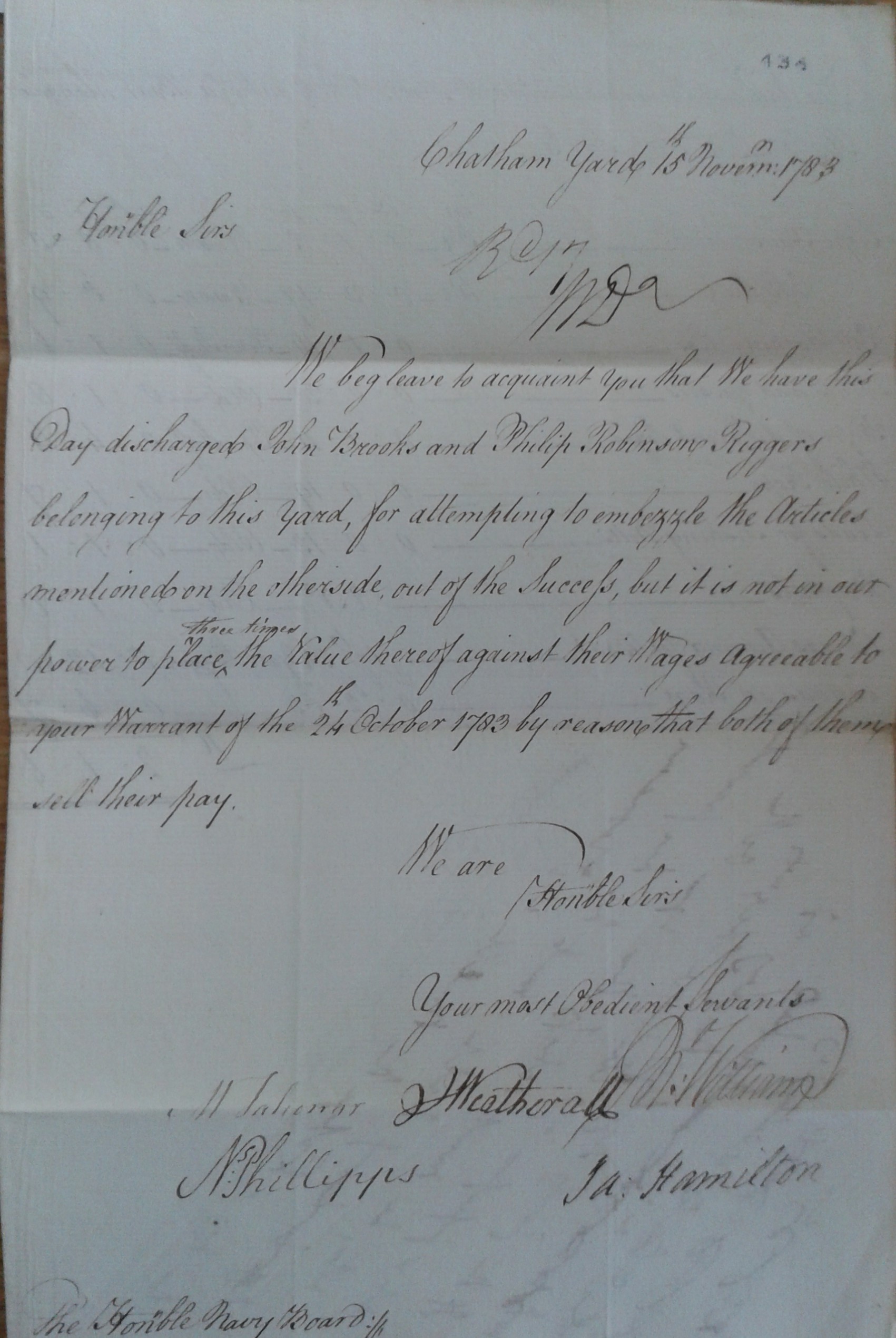
The day’s only faint sliver of hope was a letter
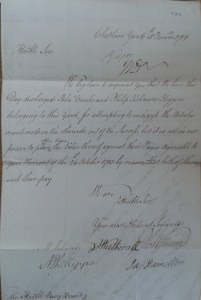
letter

Coming out of Chatham Dockyard on 15th November 1783 it says:

 “We beg leave to acquaint you that we have this day discharged John Brooks and Philip Robinson, Riggers belonging to this yard, for attempting to embezzle the articles mentioned on the otherside [of the letter] out of the Success [a ship], but it is not in our power to place three times the value thereof against their wages agreeable to your warrant of 24th October 1783 by reason that both of them sell(?) their pay…”

Which allows the ever so slight possibility that if this is our Philip (born c.1747), known to be resident in the Chatham area at that time, he may have come to Kent from elsewhere, perhaps even through the Navy. Not that it is possible to prove any link yet, there is no clue as to who his parents were as they are not mentioned on anything yet found. But it’s something and it means the day was not a complete washout.
Brief update

Many, many searches have been done and many, many document sets have been trawled, all to little avail.

There is still not much to report after weeks of searching for the perennially elusive Philip Joseph Robinson or his wife Louisa Anderson, although there is a family of Andersons from Harrismith that look a promising match without as yet an explicit link back to Louisa.

Having said that, there has actually been some progress around the periphery. A lot more has been found about Ralph Victor Robinson, PJR’s eldest son and my great-uncle. For instance Ralph was married and divorced twice – first to Lauretta Twentyman-Jones and later to Patricia Campbell (née Mayer). Both marriages were short-lived and apparently produced only one child. None of which sheds much light on the main search for his father’s birth and death, except for perhaps the most interesting thing discovered about Ralph, and which I nearly missed.

The marriage register for the wedding of Ralph and Lauretta in Wynberg says that he was born in “East Africa”, which came as a bit of a curve-ball. It means that shortly after Philip and Louisa married in 1903 and before he was employed back at De Beers in Kimberley in 1905 the couple were in British East Africa, presumably taking a chance on what briefly looked like a new land of opportunity. Much more to be discovered and the final push I needed to get up to the archives.

I’m off to Kew on the 16th.

Cape Police

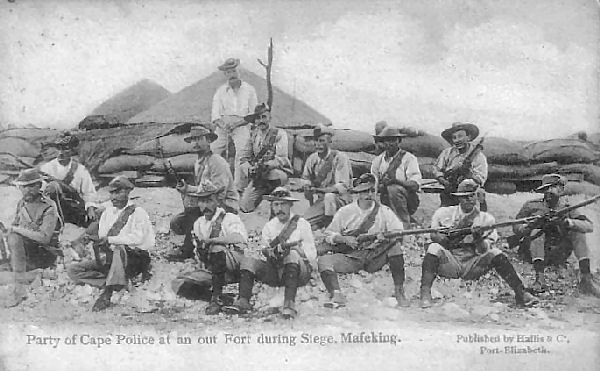
At the start of the war there were some 750 members of the Cape Police. According to angloboerwar.com, a force so ubiquitous, and its services throughout the whole war so varied, that to give a connected account of its work is impossible. This is the unit that Philip Joseph Robinson joined in September 1900 and so must be* among the 14 men pictured in this old photograph of a Cape Police unit at Mafeking.

unit of soldiers

It shows their uniform though and the almost compulsory moustache wearing.

*won’t be

A little more light

Philip Joseph Robinson it seems did not serve with the Imperial Light Horse, despite saying that he had when completing his Kimberley Horse attestation papers in May 1902. This entry from the nominal rolls has the telling addition of “no trace” above the initials ILH (left hand side).

27c2432ccb7f01b6f31a9df6b7c649f6

But it does at least add to the sum of knowledge so far.

Clearing up anomolies

To mix a metaphor, much of the last few days has been spent chasing a red herring over hill and dale. The report of a will mentioned in this post has to be examined and explained. And now it has been. The will in question refers not to Philip Joseph Robinson of Kimberley but to plain old Philip Robinson of Middleburg.

This is another example of someone taking some shared speculation and passing it on as fact, even embellishing it with middle names and a spouse. Somehow this original communication:

Philip [b4c3] left only tools of trade (£15) and a bicycle (£3) and stated in his Will that should Sir JB Robinson make any bequest to him, it to be equally divided between his son Philip [b4c3d1] and daughter Margaret Elizabeth Botha [born Robinson married to Zeiler Botha], and his grandson Philip Robinson [b4c3d1e1] and all his cattle to his grandson. Sir J.B. Robinson was the uncle of Philip [b4c3] and the brother of Philip [b4].

became this:

He (Philip Robinson) left a will in South Africa; He left only tools of trade (15 Pounds) and a bicycle (3 Pounds) and stated in his Will that should Sir JB Robinson make any bequest to him, it to be equally divided between his son Philip, married to Louisa Anderson, and daughter Margaret Elizabeth, married to Zeiler Botha, and his grandson Philip Benjamin Robinson, and all his cattle to his grandson. Sir JB was his uncle.

As you know if you’ve read the “Where it all began” section, I had made the mistake of thinking that this Philip was my ancestor when he turned out to be a great grand uncle so I suspect I share a portion of the blame for passing on the will and wondering out loud if it did refer to my great grandfather.

What’s the first rule of genealogy? Accept nothing as fact without proof!

exhibit5

New light shed

Finally, a new source for Philip Joseph Robinson that answers more questions than it poses!
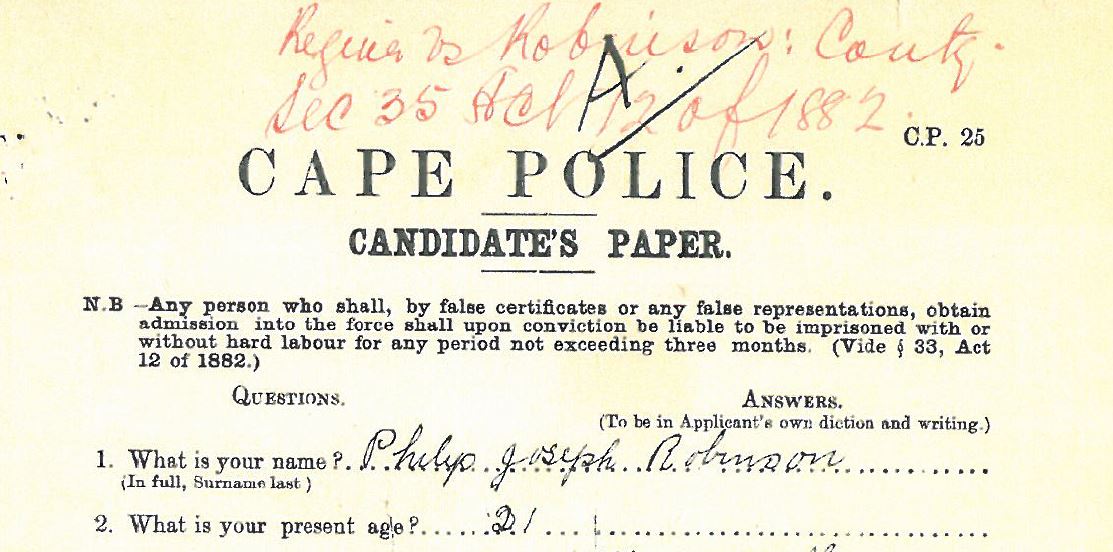
I’ve just been sent the candidate papers for when he signed up to the Cape Police.
PJR-CPI’ve updated his page incorporating the new information, which does throw a deal of new light on his early years at least. He was a butcher but had been working on the railways in the north before the war, could read and write both Dutch and English, and had no indication of venereal disease!

It’s such a good feeling when your new information actually improves your understanding.